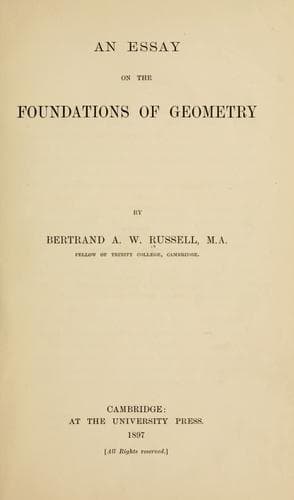
An essay on the foundations of geometryRussell, Bertrand
Philosophy
An essay on the foundations of geometry
Russell, Bertrand
Geometry -- Foundations
=198.= Let us see whether, by this change, we can overcome the
antinomy of the point. Spatial figures, we shall now say, are
relations between the matter which differentiates empty space. Their
divisibility, which seemed to contradict their relational character,
may be explained in two ways: first, as holding of the figures
considered as parts of empty space, which is itself not a relation;
second, as denoting the possibility of continuous change in the
relation expressed by the spatial figure. These two ways are, at
bottom, the same; for empty space is a possibility of relations, and
the figure, when viewed in connection with empty space, thus becomes
a _possible_ relation, with which other possible relations may be
contrasted or compared. But the second way of regarding divisibility
is the better way, since it introduces a reference to the matter
which differentiates empty space, without which, spatial figures,
and therefore Geometry, could not exist. It is empty space, then--so
we must conclude--which gives rise to the antinomy in question; for
empty space is a bare possibility of relations, undifferentiated and
homogeneous, and thus wholly destitute of parts or of thinghood.
To speak of parts of a possibility is nonsense; the parts and
differentiations arise only through a reference to the matter which
is differentiated in space.
=199.= But what nature must we ascribe to this matter, which is
to be involved in all geometrical propositions? In criticizing
Helmholtz (Chap. II. § 73), it may be remembered, we decided that
Geometry refers to a peculiar and abstract kind of matter, which is
not regarded as possessing any causal qualities, as exerting or as
subject to the action of forces. And this is the matter, I think,
which we require for the needs of the moment. Not that we affirm,
of course, that actual matter can be destitute of the properties
with which Physics is cognizant, but that we abstract from these
properties, as being irrelevant to Geometry. All that we require, for
our immediate purpose, is a subject of that diversity which space
renders possible, or terms for those relations by which empty space,
if space is to be studied at all, must be differentiated. But how
must a matter, which is to fulfil this function, be regarded?
Public-domain text, read in full here on John Shaqi.
Reviews
Reviews
No reviews yet
Be the first to share your thoughts on this work.
Elsewhere in the archive
Join the Discussion
Join the discussion
Sign in to leave a comment or review.
Sign InorCreate an account