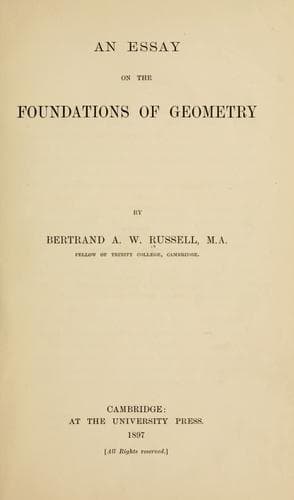
An essay on the foundations of geometryRussell, Bertrand
Philosophy
An essay on the foundations of geometry
Russell, Bertrand
Geometry -- Foundations
In the introduction to his little German book, Lobatchewsky laments
the slight interest shown in his writings by his compatriots, and the
inattention of mathematicians, since Legendre's abortive attempt, to
the difficulties in the theory of parallels. The body of the work
begins with the enunciation of several important propositions which
hold good in the system proposed as well as in Euclid: of these, some
are in any case independent of the axiom of parallels, while others
are rendered so by substituting, for the word "parallel," the phrase
"not intersecting, however far produced." Then follows a definition,
intentionally framed so as to contradict Euclid's: With respect to
a given straight line, all others in the same plane may be divided
into two classes, those which cut the given straight line, and those
which do not cut it; a line which is the limit between the two
classes is called _parallel_ to the given straight line. It follows
that, from any external point, two parallels can be drawn, one in
each direction. From this starting-point, by the Euclidean synthetic
method, a series of propositions are deduced; the most important of
these is, that in a triangle the sum of the angles is always less
than, or always equal to two right angles, while in the latter case
the whole system becomes orthodox. A certain analogy with spherical
Geometry--whose meaning and extent will appear later--is also proved,
consisting roughly in the substitution of hyperbolic for circular
functions.
Public-domain text, read in full here on John Shaqi.
Reviews
Reviews
No reviews yet
Be the first to share your thoughts on this work.
Join the Discussion
Join the discussion
Sign in to leave a comment or review.
Sign InorCreate an account