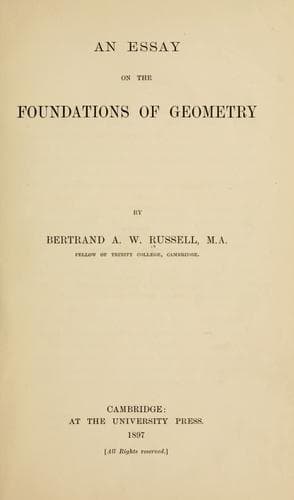
An essay on the foundations of geometryRussell, Bertrand
Philosophy
An essay on the foundations of geometry
Russell, Bertrand
Geometry -- Foundations
=14.= Very similar is the system of _Johann Bolyai_, so similar,
indeed, as to make the independence of the two works, though a
well-authenticated fact, seem all but incredible. Johann Bolyai
first published his results in 1832, in an appendix to a work by his
father Wolfgang, entitled; "Appendix, scientiam spatii absolute veram
exhibens: a veritate aut falsitate Axiomatis XI. Euclidei (a priori
haud unquam decidenda) independentem; adjecta ad casum falsitatis,
quadratura circuli geometrica." Gauss, whose bosom friend he became
at college and remained through life, was, as we have seen, the
inspirer of Wolfgang Bolyai, and used to say that the latter was the
only man who appreciated his philosophical speculations on the axioms
of Geometry; nevertheless, Wolfgang appears to have left to his son
Johann the detailed working out of the hyperbolic system. The works
of both the Bolyai are very rare, and their method and results are
known to me only through the renderings of Frischauf and Halsted[13].
Both as to method and as to results, the system is very similar to
Lobatchewsky's, so that neither need detain us here. Only the initial
postulates, which are more explicit than Lobatchewsky's, demand a
brief attention. Frischauf's introduction, which has a philosophical
and Newtonian air, begins by setting forth that Geometry deals with
absolute (empty) space, obtained by abstracting from the bodies in
it, that two figures are called congruent when they differ only in
position, and that the axiom of Congruence is indispensable in all
determination of spatial magnitudes. Congruence was to refer to
geometrical bodies, with none of the properties of ordinary bodies
except impenetrability (Erdmann, Axiome der Geometrie, p. 26). A
straight line is defined as determined by two of its points[14],
and a plane as determined by three. These premisses, with a slight
exception as to the straight line, we shall hereafter find essential
to every Geometry. I have drawn attention to them, as it is often
supposed that non-Euclideans deny the axiom of Congruence, which,
here and elsewhere, is never the case. The stress laid on this axiom
by Bolyai is probably due to the influence of Gauss, whose work on
the curvature of surfaces laid the foundation for the use made of
congruence by Helmholtz.
Public-domain text, read in full here on John Shaqi.
Reviews
Reviews
No reviews yet
Be the first to share your thoughts on this work.
Join the Discussion
Join the discussion
Sign in to leave a comment or review.
Sign InorCreate an account