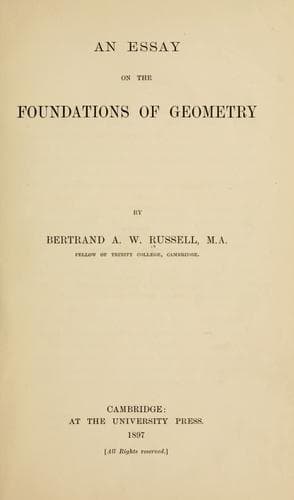
An essay on the foundations of geometryRussell, Bertrand
Philosophy
An essay on the foundations of geometry
Russell, Bertrand
Geometry -- Foundations
believed them to be unnecessary, were always introduced in their
mathematical works, before laying the foundations of non-Euclidean
systems. I shall contend, in Chapter III., that this retention was
logically inevitable, and was not merely due, as they supposed, to a
desire for conformity with experience. If I am right in this, there
is a divergence between Riemann and Helmholtz the philosophers, and
Riemann and Helmholtz the mathematicians. This divergence makes it
the more desirable to trace the mathematical development apart from
the accompanying philosophy.
=17.= _Riemann's_ epoch-making work, "_Ueber die Hypothesen, welche
der Geometrie zu Grande liegen_[16]", was written, and read to a
small circle, in 1854; owing, however, to some changes which he
desired to make in it, it remained unpublished till 1867, when it
was published by his executors. The two fundamental conceptions, on
whose invention rests the historic importance of this dissertation,
are that of a _manifold_, and that of the _measure of curvature_
of a manifold. The former conception serves a mainly philosophical
purpose, and is designed, principally, to exhibit space as an
instance of a more general conception. On this aspect of the
manifold, I shall have much to say in Chapter II.; its mathematical
aspect, which alone concerns us here, is less complicated and less
fruitful of controversy. The latter conception also serves a double
purpose, but its mathematical use is the more prominent. We will
consider these two conceptions successively.
=18.= (1) _Conception of a manifold[17]._ The general purpose of
Riemann's dissertation is, to exhibit the axioms as successive steps
in the classification of the species space. The axioms of Geometry,
like the marks of a scholastic definition, appear as successive
determinations of class-conceptions, ending with Euclidean space.
We have thus, from the analytical point of view, about as logical
and precise a formulation as can be desired--a formulation in which,
from its classificatory character, we seem certain of having nothing
superfluous or redundant, and obtain the axioms explicitly in the
most desirable form, namely as adjectives of the conception of
space. At the same time, it is a pity that Riemann, in accordance
with the metrical bias of his time, regarded space as primarily a
magnitude[18], or assemblage of magnitudes, in which the main problem
consists in assigning quantities to the different elements or points,
without regard to the qualitative nature of the quantities assigned.
Considerable obscurity thus arises as to the whole nature of
magnitude[19]. This view of Geometry underlies the definition of the
manifold, as the general conception of which space forms a special
case. This definition, which is not very clear, may be rendered as
follows.
Public-domain text, read in full here on John Shaqi.
Reviews
Reviews
No reviews yet
Be the first to share your thoughts on this work.
Join the Discussion
Join the discussion
Sign in to leave a comment or review.
Sign InorCreate an account