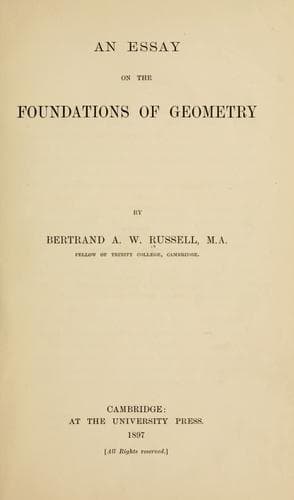
An essay on the foundations of geometryRussell, Bertrand
Philosophy
An essay on the foundations of geometry
Russell, Bertrand
Geometry -- Foundations
=15.= It is important to remember that, throughout the period we have
just reviewed, the purpose of hyperbolic Geometry is indirect: not
the truth of the latter, but the logical independence of the axiom
of parallels from the rest, is the guiding motive of the work. If,
by denying the axiom of parallels while retaining the rest, we can
obtain a system free from logical contradictions, it follows that
the axiom of parallels cannot be implicitly contained in the others.
If this be so, attempts to dispense with the axiom, like Legendre's,
cannot be successful; Euclid must stand or fall with the suspected
axiom. Of course, it remained possible that, by further development,
latent contradictions might have been revealed in these systems. This
possibility, however, was removed by the more direct and constructive
work of the second period, to which we must now turn our attention.
Second Period.
=16.= The work of Lobatchewsky and Bolyai remained, for nearly a
quarter of a century, without issue--indeed, the investigations
of Riemann and Helmholtz, when they came, appear to have been
inspired, not by these men, but rather by Gauss[15] and Herbart. We
find, accordingly, very great difference, both of aim and method,
between the first period and the second. The former, beginning
with a criticism of one point in Euclid's system, preserved his
synthetic method, while it threw over one of his axioms. The latter,
on the contrary, being guided by a philosophical rather than a
mathematical spirit, endeavoured to classify the conception of
space as a species of a more general conception: it treated space
algebraically, and the properties it gave to space were expressed
in terms, not of intuition, but of algebra. The aim of Riemann and
Helmholtz was to show, by the exhibition of logically possible
alternatives, the empirical nature of the received axioms. For this
purpose, they conceived space as a particular case of a manifold,
and showed that various relations of magnitude (_Massverhältnisse_)
were mathematically possible in an extended manifold. Their
philosophy, which seems to me not always irreproachable, will be
discussed in Chapter II.; here, while it is important to remember
the philosophical motive of Riemann and Helmholtz, we shall confine
our attention to the mathematical side of their work. In so doing,
while we shall, I fear, somewhat maim the system of their thoughts,
we shall secure a closer unity of subject, and a more compact
account of the purely mathematical development. But there is, in my
opinion, a further reason for separating their philosophy from their
mathematics. While their philosophical purpose was, to prove that all
the axioms of Geometry are empirical, and that a different content of
our experience might have changed them all, the unintended result of
their mathematical work was, if I am not mistaken, to afford material
for an _à priori_ proof of certain axioms. These axioms, though they
Public-domain text, read in full here on John Shaqi.
Reviews
Reviews
No reviews yet
Be the first to share your thoughts on this work.
Join the Discussion
Join the discussion
Sign in to leave a comment or review.
Sign InorCreate an account