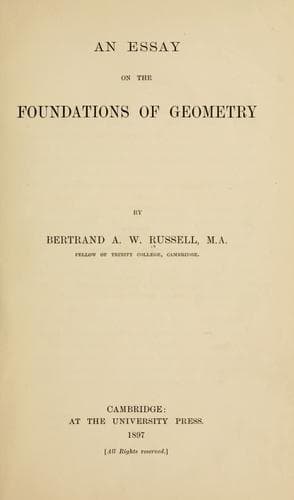
An essay on the foundations of geometryRussell, Bertrand
Philosophy
An essay on the foundations of geometry
Russell, Bertrand
Geometry -- Foundations
But to proceed with the mathematical development of Riemann's
ideas. We have seen that he declared measurement to consist in
a superposition of the magnitudes to be compared. But in order
that this may be a possible means of determining magnitudes, he
continues, these magnitudes must be independent of their position
in the manifold (p. 259). This can occur, he says, in several ways,
as the simplest of which, he assumes that the lengths of lines are
independent of their position. One would be glad to know what other
ways are possible: for my part, I am unable to imagine any other
hypothesis on which magnitude would be independent of place. Setting
this aside, however, the problem, owing to the fact that measurement
consists in superposition, becomes identical with the determination
of the most general manifold in which magnitudes are independent of
place. This brings us to Riemann's other fundamental conception,
which seems to me even more fruitful than that of a manifold.
=20.= (2) _Measure of curvature._ This conception is due to Gauss,
but was applied by him only to surfaces; the novelty in Riemann's
dissertation was its extension to a manifold of _n_ dimensions.
This extension, however, is rather briefly and obscurely expressed,
and has been further obscured by Helmholtz's attempts at popular
exposition. The term _curvature_, also, is misleading, so that
the phrase has been the source of more misunderstanding, even
among mathematicians, than any other in Pangeometry. It is often
forgotten, in spite of Helmholtz's explicit statement[20], that the
"measure of curvature" of an _n_-dimensional manifold is a purely
analytical expression, which has only a symbolic affinity to ordinary
curvature. As applied to three-dimensional space, the implication
of a four-dimensional "plane" space is wholly misleading; I shall,
therefore, generally use the term space-constant instead[21].
Nevertheless, as the conception grew, historically, out of that of
curvature, I will give a very brief exposition of the historical
development of theories of curvature.
Public-domain text, read in full here on John Shaqi.
Reviews
Reviews
No reviews yet
Be the first to share your thoughts on this work.
Join the Discussion
Join the discussion
Sign in to leave a comment or review.
Sign InorCreate an account