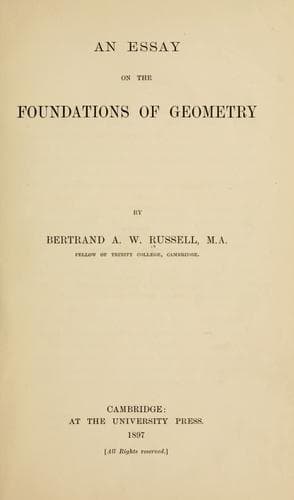
An essay on the foundations of geometryRussell, Bertrand
Philosophy
An essay on the foundations of geometry
Russell, Bertrand
Geometry -- Foundations
Just as the notion of _length_ was originally derived from the
straight line, and extended to other curves by dividing them into
infinitesimal straight lines, so the notion of _curvature_ was
derived from the circle, and extended to other curves by dividing
them into infinitesimal circular arcs. Curvature may be regarded,
originally, as a measure of the amount by which a curve departs from
a straight line; in a circle, which is similar throughout, this
amount is evidently constant, and is measured by the reciprocal
of the radius. But in all other curves, the amount of curvature
varies from point to point, so that it cannot be measured without
infinitesimals. The measure which at once suggests itself is, the
curvature of the circle most nearly coinciding with the curve at the
point considered. Since a circle is determined by three points, this
circle will pass through three consecutive points of the curve. We
have thus defined the curvature of any curve, plane or tortuous; for,
since any three points lie in a plane, such a circle can always be
described.
If we now pass to a surface, what we want is, by analogy, a measure
of its departure from a plane. The curvature, as above defined, has
become indeterminate, for through any point of the surface we can
draw an infinite number of arcs, which will not, in general, all
have the same curvature. Let us, then, draw all the geodesics joining
the point in question to neighbouring points of the surface in all
directions. Since these arcs form a singly infinite manifold, there
will be among them, if they have not all the same curvature, one arc
of maximum, and one of minimum curvature[22]. The product of these
maximum and minimum curvatures is called the _measure of curvature_
of the surface at the point under consideration. To illustrate by a
few simple examples: on a sphere, the curvatures of all such lines
are equal to the reciprocal of the radius of the sphere, hence the
measure of curvature everywhere is the square of the reciprocal
of the radius of the sphere. On any surface, such as a cone or
a cylinder, on which straight lines can be drawn, these have no
curvature, so that the measure of curvature is everywhere zero--this
is the case, in particular, with the plane. In general, however, the
measure of curvature of a surface varies from point to point.
Public-domain text, read in full here on John Shaqi.
Reviews
Reviews
No reviews yet
Be the first to share your thoughts on this work.
Join the Discussion
Join the discussion
Sign in to leave a comment or review.
Sign InorCreate an account