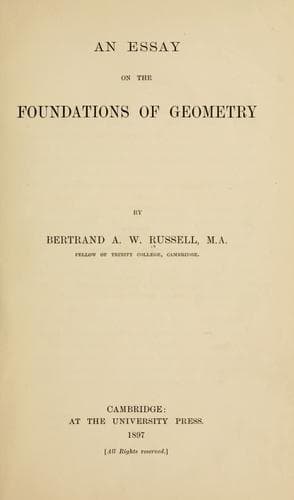
An essay on the foundations of geometryRussell, Bertrand
Philosophy
An essay on the foundations of geometry
Russell, Bertrand
Geometry -- Foundations
These, as we
shall see hereafter, are retained, in actual mathematical work, by
all metrical Metageometers, even when they believe, like Riemann and
Helmholtz, that no axioms are philosophically indispensable.
=24.= _Helmholtz_, the historically nearest follower of Riemann, was
guided by a similar empirical philosophy, and arrived independently
at a very similar method of formulating the axioms. Although
Helmholtz published nothing on the subject until after Riemann's
death, he had then only just seen Riemann's dissertation (which was
published posthumously), and had worked out his results, so far as
they were then completed, in entire independence both of Riemann
and of Lobatchewsky. Helmholtz is by far the most widely read of all
writers on Metageometry, and his writings, almost alone, represent
to philosophers the modern mathematical standpoint on this subject.
But his importance is much greater, in this domain, as a philosopher
than as a mathematician; almost his only original mathematical
result, as regards Geometry, is his proof of Riemann's formula for
the infinitesimal arc, and even this proof was far from rigid, until
Lie reformed it by his method of continuous groups. In this chapter,
therefore, only two of his writings need occupy us, namely the two
articles in the _Wissenschaftliche Abhandlungen_, Vol. II., entitled
respectively "Ueber die thatsächlichen Grundlagen der Geometrie,"
1866 (p. 610 ff.), and "Ueber die Thatsachen, die der Geometrie zum
Grunde liegen," 1868 (p. 618 ff.).
=25.= In the first of these, which is chiefly philosophical,
Helmholtz gives hints of his then uncompleted mathematical work,
but in the main contents himself with a statement of results. He
announces that he will prove Riemann's quadratic formula for the
infinitesimal arc; but for this purpose, he says, we have to _start_
with Congruence, since without it spatial measurement is impossible.
Nevertheless, he maintains that Congruence is proved by experience.
How we could, without the help of measurement, discover lapses
from Congruence, is a point which he leaves undiscussed. He then
enunciates the four axioms which he considers essential to Geometry,
as follows:
(1) _As regards continuity and dimensions._ In a space of _n_
dimensions, a point is uniquely determined by the measurement of _n_
continuous variables (coordinates).
(2) _As regards the existence of moveable rigid bodies._ Between the
2_n_ coordinates of any point-pair of a rigid body, there exists
an equation which is the same for all congruent point-pairs. By
considering a sufficient number of point-pairs, we get more equations
than unknown quantities: this gives us a method of determining the
form of these equations, so as to make it possible for them all to be
satisfied.
Public-domain text, read in full here on John Shaqi.
Reviews
Reviews
No reviews yet
Be the first to share your thoughts on this work.
Join the Discussion
Join the discussion
Sign in to leave a comment or review.
Sign InorCreate an account