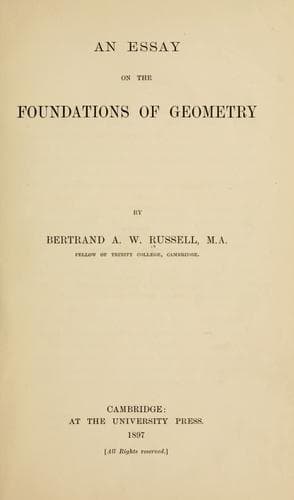
An essay on the foundations of geometryRussell, Bertrand
Philosophy
An essay on the foundations of geometry
Russell, Bertrand
Geometry -- Foundations
(3) _As regards free mobility._ Every point can pass freely and
continuously from one position to another. From (2) and (3) it
follows, that if two systems _A_ and _B_ can be brought into
congruence in any one position, this is also possible in every other
position.
(4) _As regards independence of rotation in rigid bodies_
(Monodromy). If (_n_ - 1) points of a body remain fixed, so that every
other point can only describe a certain curve, then that curve is
closed.
These axioms, says Helmholtz, suffice to give, with the axiom of
three dimensions, the Euclidean and non-Euclidean systems as the only
alternatives. That they _suffice_, mathematically, cannot be denied,
but they seem, in some respects, to go too far. In the first place,
there is no necessity to make the axiom of Congruence apply to actual
rigid bodies--on this subject I have enlarged in Chapter II.[29]
Again, Free Mobility, as distinct from Congruence, hardly needs to
be specially formulated: what barrier could empty space offer to a
point's progress? The axiom is involved in the homogeneity of space,
which is the same thing as the axiom of Congruence. Monodromy, also,
has been severely criticized; not only is it evident that it might
have been included in Congruence, but even from the purely analytical
point of view, Sophus Lie has proved it to be superfluous[30]. Thus
the axiom of Congruence, rightly formulated, includes Helmholtz's
third and fourth axioms and part of his second axiom. All the
four, or rather, as much of them as is relevant to Geometry, are
consequences, as we shall see hereafter, of the one fundamental
principle of the relativity of position.
Public-domain text, read in full here on John Shaqi.
Reviews
Reviews
No reviews yet
Be the first to share your thoughts on this work.
Join the Discussion
Join the discussion
Sign in to leave a comment or review.
Sign InorCreate an account