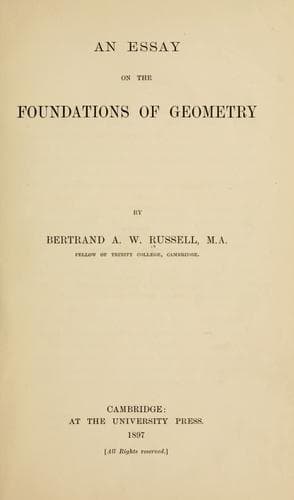
An essay on the foundations of geometryRussell, Bertrand
Philosophy
An essay on the foundations of geometry
Russell, Bertrand
Geometry -- Foundations
=26.= The second article, which is mainly mathematical, supplies
the promised proof of the arc-formula, which is Helmholtz's most
important contribution to Geometry. Riemann had _assumed_ this
formula, as the simplest of a number of alternatives: Helmholtz
proved it to be a necessary consequence of his axioms. The present
paper begins with a short repetition of the first, including the
statement of the axioms, to which, at the end of the paper, two more
are added, (5) that space has three dimensions, and (6) that space is
infinite. It is supposed in the text, as also in the first paper,
that the measure of curvature cannot be negative, and, consequently,
that an infinite space must be Euclidean. This error in both papers
is corrected in notes, added after the appearance of Beltrami's paper
on negative curvature. It is a sample of the slightly unprofessional
nature of Helmholtz's mathematical work on this subject, which
elicits from Klein the following remarks[31]: "Helmholtz is not a
mathematician by profession, but a physicist and physiologist....
From this non-mathematical quality of Helmholtz, it follows naturally
that he does not treat the mathematical portion of his work with the
thoroughness which one would demand of a mathematician by trade (_von
Fach_)." He tells us himself that it was the physiological study of
vision which led him to the question of the axioms, and it is as a
physicist that he makes his axioms refer to actual rigid bodies.
Accordingly, we find errors in his mathematics, such as the axiom
of Monodromy, and the assumption that the measure of curvature must
be positive. Nevertheless, the proof of Riemann's arc-formula is
extremely able, and has, on the whole, been substantiated by Lie's
more thorough investigations.
=27.= Helmholtz's other writings on Geometry are almost wholly
philosophical, and will be discussed at length in Chapter II. For the
present, we may pass to the only other important writer of the second
period, _Beltrami_. As his work is purely mathematical, and contains
few controverted points, it need not, despite its great importance,
detain us long.
Public-domain text, read in full here on John Shaqi.
Reviews
Reviews
No reviews yet
Be the first to share your thoughts on this work.
Join the Discussion
Join the discussion
Sign in to leave a comment or review.
Sign InorCreate an account