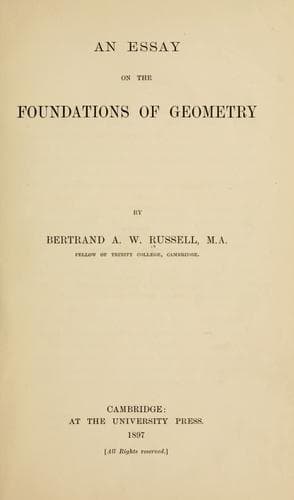
An essay on the foundations of geometryRussell, Bertrand
Philosophy
An essay on the foundations of geometry
Russell, Bertrand
Geometry -- Foundations
=29.= The value of Beltrami's Saggio, in his own eyes, lies in
the intelligible Euclidean sense which it gives to Lobatchewsky's
planimetry: the corresponding system of Solid Geometry, since it has
no meaning for Euclidean space, is barely mentioned in this work.
In a second paper[37], however, almost contemporaneous with the
first, he proceeds to consider the general theory of _n_-dimensional
manifolds of constant negative curvature. This paper is greatly
influenced by Riemann's dissertation; it begins with the formula
for the linear element, and proves from this first, that Congruence
holds for such spaces, and next, that they have, according to
Riemann's definition, a constant negative measure of curvature. (It
is instructive to observe, that both in this and in the former Essay,
great stress is laid on the necessity of the Axiom of Congruence.)
This work has less philosophical interest than the former, since it
does little more than repeat, in a general form, the results which
the Saggio had obtained for two dimensions--results which sink,
when extended to _n_ dimensions, to the level of mere mathematical
constructions. Nevertheless, the paper is important, both as a
restoration of negative curvature, which had been overlooked
by Helmholtz, and as an analytical treatment of Lobatchewsky's
results--a treatment which, together with the Saggio, at last
restored to them the prominence they deserved.
Third Period.
=30.= The third period differs radically, alike in its methods and
aims, and in the underlying philosophical ideas, from the period
which it replaced. Whereas everything, in the second period, turned
on measurement, with its apparatus of Congruence, Free Mobility,
Rigid Bodies, and the rest, these vanish completely in the third
period, which, swinging to the opposite extreme, regards quantity
as a perfectly irrelevant category in Geometry, and dispenses with
congruence and the method of superposition. The ideas of this period,
unfortunately, have found no exponent so philosophical as Riemann or
Helmholtz, but have been set forth only by technical mathematicians.
Moreover the change of fundamental ideas, which is immense, has
not brought about an equally great change in actual procedure; for
though spatial quantity is no longer a part of projective Geometry,
quantity is still employed, and we still have equations, algebraic
transformations, and so on. This is apt to give rise to confusion,
especially in the mind of the student, who fails to realise that the
quantities used, so far as the propositions are really projective,
are mere names for points, and not, as in metrical Geometry, actual
spatial magnitudes.
Public-domain text, read in full here on John Shaqi.
Reviews
Reviews
No reviews yet
Be the first to share your thoughts on this work.
Join the Discussion
Join the discussion
Sign in to leave a comment or review.
Sign InorCreate an account