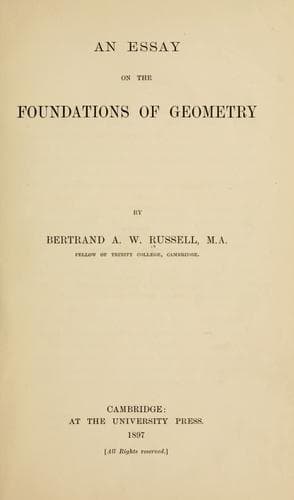
An essay on the foundations of geometry — John Shaqi
An essay on the foundations of geometryRussell, Bertrand
Philosophy
An essay on the foundations of geometry
Russell, Bertrand
Geometry -- Foundations
Nevertheless, the fundamental difference between this period
and the former must strike any one at once. Whereas Riemann
and Helmholtz dealt with metrical ideas, and took, as their
foundations, the measure of curvature and the formula for the linear
element--both purely metrical--the new method is erected on the
formulae for transformation of coordinates required to express a
given collineation. It begins by reducing all so-called metrical
notions--distance, angle, etc.--to projective forms, and obtains,
from this reduction, a methodological unity and simplicity before
impossible. This reduction depends, however, except where the
space-constant is negative, upon imaginary figures--in Euclid, the
circular points at infinity; it is moreover purely symbolic and
analytical, and must be regarded as philosophically irrelevant.
As the question concerning the import of this reduction is of
fundamental importance to our theory of Geometry, and as Cayley, in
his Presidential Address to the British Association in 1883, formally
challenged philosophers to discuss the use of imaginaries, on which
it depends, I will treat this question at some length. But first let
us see how, as a matter of mathematics, the reduction is effected.
=31.= We shall find, throughout this period, that almost
every important proposition, though misleading in its obvious
interpretation, has nevertheless, when rightly interpreted, a wide
philosophical bearing. So it is with the work of _Cayley_, the
pioneer of the projective method.
The projective formula for angles, in Euclidean Geometry, was first
obtained by Laguerre, in 1853. This formula had, however, a perfectly
Euclidean character, and it was left for Cayley to generalize
it so as to include both angles and distances in Euclidean and
non-Euclidean systems alike[38].
Public-domain text, read in full here on John Shaqi.
Reviews
Reviews
No reviews yet
Be the first to share your thoughts on this work.
Join the Discussion
Join the discussion
Sign in to leave a comment or review.
Sign InorCreate an account