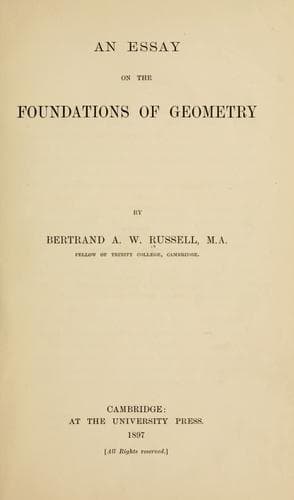
An essay on the foundations of geometryRussell, Bertrand
Philosophy
An essay on the foundations of geometry
Russell, Bertrand
Geometry -- Foundations
=35.= But what are projective coordinates, and how are they
introduced? This question was not touched upon in Cayley's Memoir,
and it seemed, therefore, as if a logical error were involved in
using coordinates to define distance. For coordinates, in all
previous systems, had been deduced from distance; to use any existing
coordinate system in defining distance was, accordingly, to incur
a vicious circle. Cayley mentions this difficulty in a note, where
he only remarks, however, that he had regarded his coordinates
as numbers arbitrarily assigned, on some system not further
investigated, to different points. The difficulty has been treated at
length by Sir R. Ball (Theory of the Content, Trans. R. I. A. 1889),
who urges that if the values of our coordinates already involve the
usual measure of distance, then to give a new definition, while
retaining the usual coordinates, is to incur a contradiction. He
says (op. cit. p. 1): "In the study of non-Euclidean Geometry I have
often felt a difficulty which has, I know, been shared by others. In
that theory it seems as if we try to replace our ordinary notion of
distance between two points by the logarithm of a certain anharmonic
ratio[46]. But this ratio itself involves the notion of distance
measured in the ordinary way. How, then, can we supersede our old
notion of distance by the non-Euclidean notion, inasmuch as the very
definition of the latter involves the former?"
=36.= This objection is valid, we must admit, so long as anharmonic
ratio is defined in the ordinary metrical manner. It would be
valid, for example, against any attempt to found a new definition
of distance on Cremona's account of anharmonic ratio[47], in
which it appears as a metrical property unaltered by projective
transformation. If a logical error is to be avoided, in fact, all
reference to spatial magnitude of any kind must be avoided; for all
spatial magnitude, as will be shown hereafter[48], is logically
dependent on the fundamental magnitude of distance. Anharmonic
ratio and coordinates must alike be defined by purely descriptive
properties, if the use afterwards made of them is to be free from
metrical presuppositions, and therefore from the objections of Sir R.
Ball.
Public-domain text, read in full here on John Shaqi.
Reviews
Reviews
No reviews yet
Be the first to share your thoughts on this work.
Join the Discussion
Join the discussion
Sign in to leave a comment or review.
Sign InorCreate an account