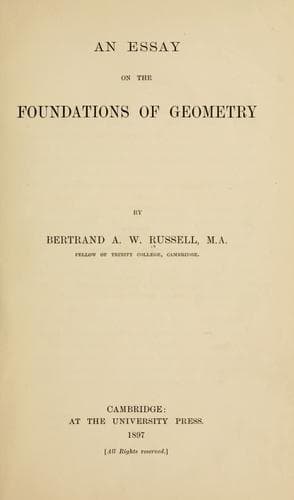
An essay on the foundations of geometryRussell, Bertrand
Philosophy
An essay on the foundations of geometry
Russell, Bertrand
Geometry -- Foundations
=33.= Since these systems are all obtained from a Euclidean plane,
by a mere alteration in the definition of distance, Cayley and
Klein tend to regard the whole question as one, not of the nature
of space, but of the definition of distance. Since this definition,
on their view, is perfectly arbitrary, the philosophical problem
vanishes--Euclidean _space_ is left in undisputed possession, and
the only problem remaining is one of convention and mathematical
convenience[42]. This view has been forcibly expressed by Poincaré:
"What ought one to think," he says, "of this question: Is the
Euclidean Geometry true? The question is nonsense." Geometrical
axioms, according to him, are mere conventions: they are "definitions
in disguise[43]." Thus Klein blames Beltrami for regarding his
auxiliary plane as merely auxiliary, and remarks that, if he had
known Cayley's Memoir, he would have seen the relation between
the plane and the pseudosphere to be far more intimate than he
supposed[44]. A view which removes the problem entirely from the
arena of philosophy demands, plainly, a full discussion. To this
discussion we will now proceed.
=34.= The view in question has arisen, it would seem, from a natural
confusion as to the nature of the coordinates employed. Those who
hold the view have not adequately realised, I believe, that their
coordinates are not _spatial_ quantities, as in metrical Geometry,
but mere conventional signs, by which different points can be
distinctly designated. There is no reason, therefore, until we
already have metrical Geometry, for regarding one function of the
coordinates as a better expression of distance than another, so
long as the fundamental addition-equation[45] is preserved. Hence,
if our coordinates are regarded as adequate for all Geometry, an
indeterminateness arises in the expression of distance, which can
only be avoided by a convention. But projective coordinates--so our
argument will contend--though perfectly adequate for all projective
properties, and entirely free from any metrical presupposition, are
inadequate to express metrical properties, just because they have
no metrical presupposition. Thus where metrical properties are in
question, Beltrami remains justified as against Klein; the reduction
of metrical to projective properties is only apparent, though
the independence of these last, as against metrical Geometry, is
perfectly real.
Public-domain text, read in full here on John Shaqi.
Reviews
Reviews
No reviews yet
Be the first to share your thoughts on this work.
Join the Discussion
Join the discussion
Sign in to leave a comment or review.
Sign InorCreate an account