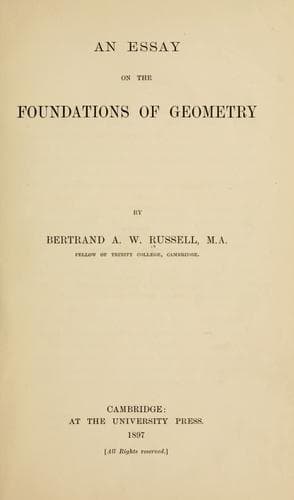
An essay on the foundations of geometryRussell, Bertrand
Philosophy
An essay on the foundations of geometry
Russell, Bertrand
Geometry -- Foundations
This confusion, I believe, has actually occurred, in the case of
those who regard the question between Euclid and Metageometry as
one of the definition of distance. Distance is a quantitative
relation, and as such presupposes identity of quality. But projective
Geometry deals only with quality--for which reason it is called
descriptive--and cannot distinguish between two figures which are
qualitatively alike. Now the meaning of qualitative likeness,
in Geometry, is the possibility of mutual transformation by a
collineation[53]. Any two pairs of points on the same straight line,
therefore, are qualitatively alike; their only qualitative relation
is the straight line, which both pairs have in common; and it is
exactly the qualitative identity of the relations of the two pairs,
which enables the difference of their relations to be exhaustively
dealt with by quantity, as a difference of distance. But where
quantity is excluded, any two pairs of points on the same straight
line appear as alike, and even any two sets of three: for any three
points on a straight line can be projectively transformed into any
other three. It is only with _four_ points in a line that we acquire
a projective property distinguishing them from other sets of four,
and this property is anharmonic ratio, descriptively defined. The
projective Geometer, therefore, sees no reason to give a name to the
relation between two points, in so far as this relation is anything
over and above the unlimited straight line on which they lie; and
when he introduces the notion of distance, he defines it, in the
only way in which projective principles allow him to define it, as a
relation between _four_ points. As he nevertheless wishes the word
to give him the power of distinguishing between different _pairs_
of points, he agrees to take two out of the four points as fixed.
In this way, the only variables in distance are the two remaining
points, and distance appears, therefore, as a function of _two_
variables, namely the coordinates of the two variable points. When we
have further defined our function so that distance may be additive,
we have a function with many of the properties of distance in the
ordinary sense. This function, therefore, the projective Geometer
regards as the only proper definition of distance.
We can see, in fact, from the manner in which our projective
coordinates were introduced, that _some_ function of these
coordinates must express distance in the ordinary sense. For
they were introduced serially, so that, as we proceeded from the
zero-point towards the infinity-point, our coordinates continually
grew. To every point, a definite coordinate corresponded: to the
distance between two variable points, therefore, as a function
dependent on no other variables, must correspond some definite
function of the coordinates, since these are themselves functions of
their points. The function discussed above, therefore, must certainly
include distance in the ordinary sense.
Public-domain text, read in full here on John Shaqi.
Reviews
Reviews
No reviews yet
Be the first to share your thoughts on this work.
Join the Discussion
Join the discussion
Sign in to leave a comment or review.
Sign InorCreate an account