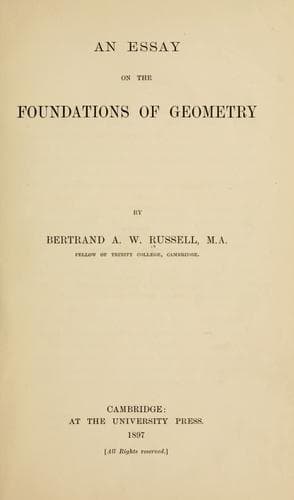
An essay on the foundations of geometryRussell, Bertrand
Philosophy
An essay on the foundations of geometry
Russell, Bertrand
Geometry -- Foundations
But the arbitrary and conventional nature of distance, as maintained
by Poincaré and Klein, arises from the fact that the two fixed
points, required to determine our distance in the projective sense,
may be arbitrarily chosen, and although, when our choice is once
made, any two points have a definite distance, yet, according as we
make that choice, distance will become a different function of the
two variable points. The ambiguity thus introduced is unavoidable on
projective principles; but are we to conclude, from this, that it
is really unavoidable? Must we not rather conclude that projective
Geometry cannot adequately deal with distance? If _A_, _B_, _C_, be
three different points on a line, there must be _some_ difference
between the relation of _A_ to _B_ and of _A_ to _C_, for otherwise,
owing to the qualitative identity of all points, _B_ and _C_ could
not be distinguished. But such a difference involves a relation,
between _A_ and _B_, which is independent of other points on the
line; for unless we have such a relation, the other points cannot
be distinguished as different. Before we can distinguish the two
fixed points, therefore, from which the projective definition
starts, we must already suppose some relation, between any two
points on our line, in which they are independent of other points;
and this relation is distance in the ordinary sense[54]. When we
have measured this quantitative relation by the ordinary methods
of metrical Geometry, we can proceed to decide what base-points
must be chosen, on our line, in order that the projective function
discussed above may have the same value as ordinary distance. But
the choice of these base-points, when we are discussing distance
in the ordinary sense, is not arbitrary, and their introduction is
only a technical device. Distance, in the ordinary sense, remains
a relation between _two_ points, not between _four_; and it is the
failure to perceive that the projective sense differs from, and
cannot supersede, the ordinary sense, which has given rise to the
views of Klein and Poincaré. The question is not one of convention,
but of the irreducible metrical properties of space. To sum up:
Quantities, as used in projective Geometry, do not stand for spatial
magnitudes, but are conventional symbols for purely qualitative
spatial relations. But distance, _quâ_ quantity, presupposes identity
of quality, as the condition of quantitative comparison. Distance in
the ordinary sense is, in short, that quantitative relation, between
two points on a line, by which their difference from other points
can be defined. The projective definition, however, being unable to
distinguish a collection of less than four points from any other on
the same straight line, makes distance depend on two other points
besides those whose relation it defines. No name remains, therefore,
for distance in the ordinary sense, and many projective Geometers,
having abolished the name, believe the thing to be abolished also,
Public-domain text, read in full here on John Shaqi.
Reviews
Reviews
No reviews yet
Be the first to share your thoughts on this work.
Join the Discussion
Join the discussion
Sign in to leave a comment or review.
Sign InorCreate an account