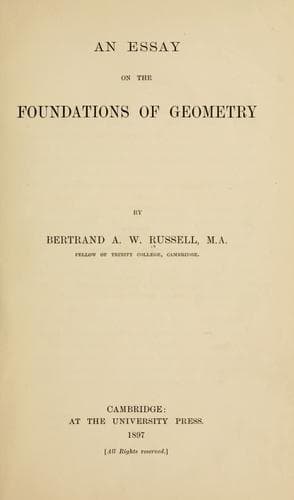
An essay on the foundations of geometry — John Shaqi
An essay on the foundations of geometryRussell, Bertrand
Philosophy
An essay on the foundations of geometry
Russell, Bertrand
Geometry -- Foundations
=39.= On the whole, then, a modification of Sir R. Ball's view,
which is practically a generalized statement of Beltrami's method,
seems the most tenable. He imagines what, with Grassmann, he calls
a Content, _i.e._ a perfectly general three-dimensional manifold,
and then correlates its elements, one by one, with points in
Euclidean space. Thus every element of the Content acquires, as its
coordinates, the ordinary Euclidean coordinates of the corresponding
point in Euclidean space. By means of this correlation, our
calculations, though they refer to the Content, are carried on, as in
Beltrami's Saggio, in ordinary Euclidean space. Thus the confusion
disappears, but with it, the supposed Euclidean interpretation also
disappears. Sir R. Ball's Content, if it is to be a space at all,
must be a space radically different from Euclid's[55]; to speak, as
Klein does, of ordinary planes with hyperbolic or elliptic measures
of distance, is either to incur a contradiction, or to forego any
metrical meaning of distance. Instead of ordinary planes, we have
surfaces like Beltrami's, of constant measure of curvature; instead
of Euclid's space, we have hyperbolic or spherical space. At the
same time, it remains true that we can, by Klein's method, give a
Euclidean meaning to every symbolic proposition in non-Euclidean
Geometry. For by substituting, for distance, the logarithm above
alluded to, we obtain, from the non-Euclidean result, a result which
follows from the ordinary Euclidean axioms. This correspondence
removes, once for all, the possibility of a lurking contradiction in
Metageometry, since, to a proposition in the one, corresponds one
and only one proposition in the other, and contradictory results in
one system, therefore, would correspond to contradictory results in
the other. Hence Metageometry cannot lead to contradictions, unless
Euclidean Geometry, at the same moment, leads to corresponding
contradictions. Thus the Euclidean plane with hyperbolic or elliptic
measure of distance, though either contradictory or not metrical
as an independent notion, has, as a help in the interpretation of
non-Euclidean results, a very high degree of utility.
Public-domain text, read in full here on John Shaqi.
Reviews
Reviews
No reviews yet
Be the first to share your thoughts on this work.
Join the Discussion
Join the discussion
Sign in to leave a comment or review.
Sign InorCreate an account