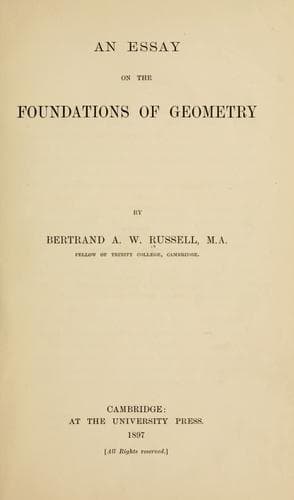
An essay on the foundations of geometryRussell, Bertrand
Philosophy
An essay on the foundations of geometry
Russell, Bertrand
Geometry -- Foundations
The projective scheme of coordinates consists of a series of numbers,
of which each represents a certain anharmonic ratio and denotes one
and only one point, and which increase uniformly with the distance
from a fixed origin, until they become infinite on reaching a certain
point. Now Cayley showed that, in Euclidean Geometry, distance may
be expressed as the limit of the logarithm of the anharmonic ratio
of the two points and the (coincident) points at infinity on their
straight line; while, if we assumed that the points at infinity were
distinct, we obtained the formula for distance in hyperbolic or
spherical Geometry, according as these points were real or imaginary.
Hence it follows that, with the projective definition of distance,
we shall obtain precisely the formulae of hyperbolic, parabolic or
spherical Geometry, according as we choose the point, to which the
value +∞ is assigned, at a finite, infinite or imaginary distance
(in the ordinary sense) from the point to which we assign the value
0. Our straight line remains, all the while, an ordinary Euclidean
straight line. But we have seen that the projective definition of
distance fits with the true definition only when the two fixed
points to which it refers are suitably chosen. Now the ordinary
meaning of distance is required in non-Euclidean as in Euclidean
Geometries--indeed, it is only in metrical properties that these
Geometries differ. Hence our _Euclidean_ straight line, though it
may serve to illustrate other Geometries than Euclid's, can only be
dealt with correctly by Euclid. Where we give a different definition
of distance from Euclid's, we are still in the domain of purely
projective properties, and derive no information as to the metrical
properties of our straight line. But the importance, to Metageometry,
of this new interpretation, lies in the fact that, having
independently established the metrical formulae of non-Euclidean
spaces, we find, as in Beltrami's Saggio, that these spaces can
be related, by a homographic correspondence, with the points of
Euclidean space; and that this can be effected in such a manner as
to give, for the distance between two points of our non-Euclidean
space, the hyperbolic or spherical measure of distance for the
corresponding points of Euclidean space.
Public-domain text, read in full here on John Shaqi.
Reviews
Reviews
No reviews yet
Be the first to share your thoughts on this work.
Join the Discussion
Join the discussion
Sign in to leave a comment or review.
Sign InorCreate an account