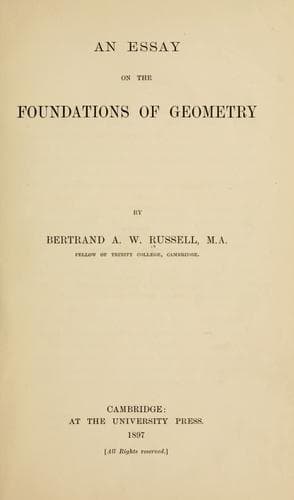
An essay on the foundations of geometryRussell, Bertrand
Philosophy
An essay on the foundations of geometry
Russell, Bertrand
Geometry -- Foundations
In this address, Professor Cayley devoted most of his time to
non-Euclidean systems. Non-Euclidean _spaces_, he declared, seemed to
him mistaken _à priori_[59]; but non-Euclidean _Geometries_, here as
in his mathematical works, were accepted as flowing from a change in
the definition of distance. This view has been already discussed, and
need not, therefore, be further criticised here. What I wish to speak
about, is the question with which Cayley himself opened his address,
namely, the geometrical use and meaning of imaginary quantities. From
the manner in which he spoke of this question, it becomes imperative
to treat it somewhat at length. For he said (pp. 8-9):
"... The notion which is the really fundamental one (and I cannot
too strongly emphasize the assertion) underlying and pervading the
whole notion of modern analysis and Geometry, [is] that of imaginary
magnitude in analysis, and of imaginary space (or space as the _locus
in quo_ of imaginary points and figures) in Geometry: I use in each
case the word imaginary as including real.... Say even the conclusion
were that the notion belongs to mere technical mathematics, or has
reference to nonentities in regard to which no science is possible,
still it seems to me that (as a subject of philosophical discussion)
the notion ought not to be thus ignored; it should at least be shown
that there is a right to ignore it."
=42.= This right it is now my purpose to demonstrate. But for fear
non-mathematicians should miss the point of Cayley's remark (which
has sometimes been erroneously supposed to refer to non-Euclidean
spaces), I may as well explain, at the outset, that this question
is radically distinct from, and only indirectly connected with, the
validity or import of Metageometry. An imaginary quantity is one
which involves √-1: its most general form is _a_ + √-1_b_ where _a_
and _b_ are real; Cayley uses the word imaginary so as to include
real, in order to cover the special case where _b_ = 0. It will
be convenient, in what follows, to exclude this wider meaning,
and assume that _b_ is not zero. An imaginary point is one whose
coordinates involve √-1, _i.e._ whose coordinates are imaginary
quantities. An imaginary curve is one whose points are imaginary--or,
in some special uses, one whose equation contains imaginary
coefficients. The mathematical subtleties to which this notion leads
need not be here discussed; the reader who is interested in them will
find an excellent elementary account of their geometrical uses in
Klein's Nicht-Euklid, II. pp. 38-46. But for our present purpose, we
may confine ourselves to imaginary points. If these are found to have
a merely technical import, and to be destitute of any philosophical
meaning, then the same will hold of any collection of imaginary
points, _i.e._ of any imaginary curve or surface.
Public-domain text, read in full here on John Shaqi.
Reviews
Reviews
No reviews yet
Be the first to share your thoughts on this work.
Join the Discussion
Join the discussion
Sign in to leave a comment or review.
Sign InorCreate an account