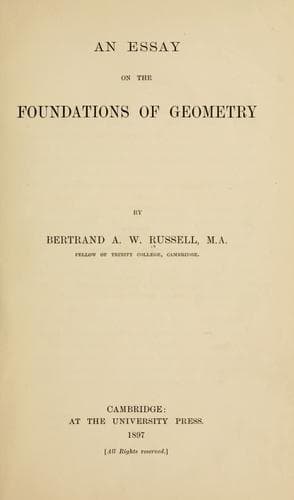
An essay on the foundations of geometryRussell, Bertrand
Philosophy
An essay on the foundations of geometry
Russell, Bertrand
Geometry -- Foundations
That the notion of imaginary points is of supreme importance in
Geometry, will be seen by any one who reflects that the circular
points are imaginary, and that the reduction of metrical to
projective Geometry, which is one of Cayley's greatest achievements,
depends on these points. But to discuss adequately their
philosophical import is difficult to me, since I am unacquainted with
any satisfactory philosophy of imaginaries in pure Algebra. I will
therefore adopt the most favourable hypothesis, and assume that no
objection can be successfully urged against this use. Even on this
hypothesis, I think, no case can be made out for imaginary points in
Geometry.
In the first place, we must exclude, from the imaginary points
considered, those whose coordinates are only imaginary with certain
special systems of coordinates. For example, if one of a point's
coordinates be the tangent from it to a sphere, this coordinate will
be imaginary for any point inside the sphere, and yet the point is
perfectly real. A point, then, is only to be called imaginary, when,
whatever real system of coordinates we adopt, one or more of the
quantities expressing these coordinates remains imaginary. For this
purpose, it is mathematically sufficient to suppose our coordinates
Cartesian--a point whose Cartesian coordinates are imaginary, is a
true imaginary point in the above sense.
To discuss the meaning of such a point, it is necessary to consider
briefly the fundamental nature of the correspondence between a
point and its coordinates. Assuming that elementary Geometry has
proved--what I think it does satisfactorily prove--that spatial
relations are susceptible of quantitative measurement, then a given
point will have, with a suitable system of coordinates, in a space
of _n_ dimensions, _n_ quantitative relations to the fixed spatial
figure forming the axes of coordinates, and these _n_ quantitative
relations will, under certain reservations, be unique--_i.e._, no
other point will have the same quantities assigned to it. (With many
possible coordinate systems, this latter condition is not realized:
but for that very reason they are inconvenient, and employed only in
special problems.) Thus given a coordinate system, and given any set
of quantities, these quantities, _if they determine a point at all_,
determine it uniquely. But, by a natural extension of the method, the
above reservation is dropped, and it is assumed that to _every_ set
of quantities some point must correspond. For this assumption there
seems to me no vestige of evidence. As well might a postman assume
that, because every house in a street is uniquely determined by its
number, therefore there must be a house for every imaginable number.
We must know, in fact, that a given set of quantities can be the
coordinates of some point in space, before it is legitimate to give
any spatial significance to these quantities: and this knowledge,
obviously, cannot be derived from operations with coordinates alone,
Public-domain text, read in full here on John Shaqi.
Reviews
Reviews
No reviews yet
Be the first to share your thoughts on this work.
Join the Discussion
Join the discussion
Sign in to leave a comment or review.
Sign InorCreate an account