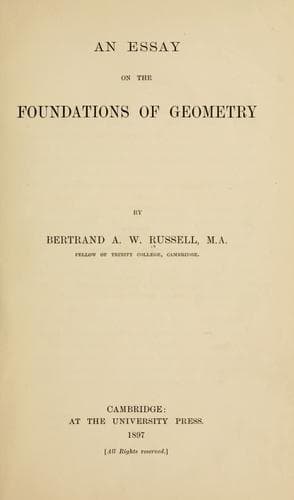
An essay on the foundations of geometry — John Shaqi
An essay on the foundations of geometryRussell, Bertrand
Philosophy
An essay on the foundations of geometry
Russell, Bertrand
Geometry -- Foundations
=43.= The fact that the fiction _is_ convenient, however, may
be thought to indicate that it is more than a fiction. But this
presumption, I think, can be easily explained away. For all the
fruitful uses of imaginaries, in Geometry, are those which begin
and end with real quantities, and use imaginaries only for the
intermediate steps. Now in all such cases, we have a real spatial
interpretation at the beginning and end of our argument, where alone
the spatial interpretation is important: in the intermediate links,
we are dealing in a purely algebraical manner with purely algebraical
quantities, and may perform any operations which are algebraically
permissible. If the quantities with which we end are capable of
spatial interpretation, then, and only then, our result may be
regarded as geometrical. To use geometrical language, in any other
case, is only a convenient help to the imagination. To speak, for
example, of projective properties which refer to the circular points,
is a mere _memoria technica_ for purely algebraical properties;
the circular points are not to be found in space, but only in the
auxiliary quantities by which geometrical equations are transformed.
That no contradictions arise from the geometrical interpretation of
imaginaries, is not wonderful: for they are interpreted solely by the
rules of Algebra, which we may admit as valid in their application
to imaginaries. The perception of space being wholly absent,
Algebra rules supreme, and no inconsistency can arise. Wherever,
for a moment, we allow our ordinary spatial notions to intrude, the
grossest absurdities do arise--every one can see that a circle, being
a closed curve, cannot get to infinity. The metaphysician, who should
invent anything so preposterous as the circular points, would be
hooted from the field. But the mathematician may steal the horse with
impunity.
Finally, then, only a knowledge of space, not a knowledge of Algebra,
can assure us that any given set of quantities will have a spatial
correlate, and in the absence of such a correlate, operations with
these quantities have no geometrical import. This is the case with
imaginaries in Cayley's sense, and their use in Geometry, great as
are its technical advantages, and rigid as is its technical validity,
is wholly destitute of philosophical importance.
Public-domain text, read in full here on John Shaqi.
Reviews
Reviews
No reviews yet
Be the first to share your thoughts on this work.
Join the Discussion
Join the discussion
Sign in to leave a comment or review.
Sign InorCreate an account