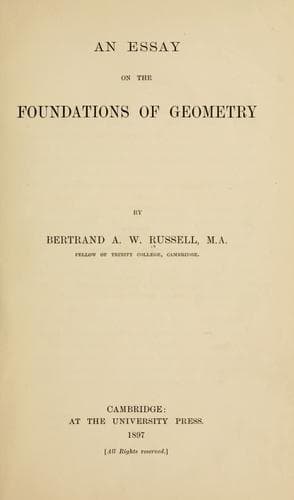
An essay on the foundations of geometryRussell, Bertrand
Philosophy
An essay on the foundations of geometry
Russell, Bertrand
Geometry -- Foundations
=44.= We have now, I think, discussed most of the questions
concerning the scope and validity of the projective method. We
have seen that it is independent of all metrical presuppositions,
and that its use of coordinates does not involve the assumption
that spatial magnitudes are measured or expressed by them. We have
seen that it is able to deal, by its own methods alone, with the
question of the qualitative likeness of geometrical figures, which
is logically prior to any comparison as to quantity, since quantity
presupposes qualitative likeness. We have seen also that, so far as
its legitimate use extends, it applies equally to all homogeneous
spaces, and that its criterion of an independently possible
space--the determination of a straight line by two points[60]--is
not subject to the qualifications and limitations which belong, as
we have seen in the case of the cylinder, to the metrical criterion
of constant curvature. But we have also seen that, when projective
Geometry endeavours to grapple with spatial magnitude, and bring
distance and the measurement of angles beneath its sway, its success,
though technically valid and important, is philosophically an
apparent success only. Metrical Geometry, therefore, if quantity is
to be applied to space at all, remains a separate, though logically
subsequent branch of Mathematics.
=45.= It only remains to say a few words about _Sophus Lie_. As a
mathematician, as the inventor of a new and immensely powerful method
of analysis, he cannot be too highly praised. Geometry is only one
of the numerous subjects to which his theory of continuous groups
applies, but its application to Geometry has made a revolution in
method, and has rendered possible, in such problems as Helmholtz's, a
treatment infinitely more precise and exhaustive than any which was
possible before.
The general definition of a group is as follows: If we have any
number of independent variables _x{1}x{2}...x{n}_, and
any series of transformations of these into new variables--the
transformations being defined by equations of specified forms,
with parameters varying from one transformation to another--then
the series of transformations form a _group_, if the successive
application of any two is equivalent to a single member of the
original series of transformations. The group is _continuous_, when
we can pass, by infinitesimal gradations within the group, from any
one of the transformations to any other.
Public-domain text, read in full here on John Shaqi.
Reviews
Reviews
No reviews yet
Be the first to share your thoughts on this work.
Join the Discussion
Join the discussion
Sign in to leave a comment or review.
Sign InorCreate an account