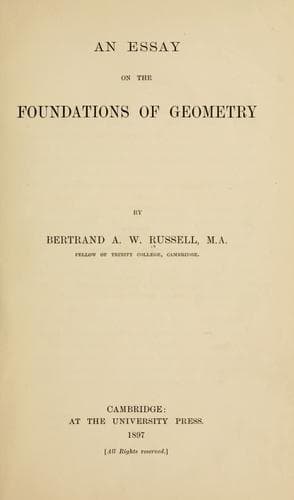
An essay on the foundations of geometryRussell, Bertrand
Philosophy
An essay on the foundations of geometry
Russell, Bertrand
Geometry -- Foundations
86. (1) He regards the possibility of non-Euclidean spaces as
suggested by the subjectivity of space, 93
87. And rejects it owing to a mathematical misunderstanding, 96
88. Having missed the most important sense of their possibility, 96
89. Which is that they fulfil the logical conditions to which any
form of externality must conform 97
90. (2) He attacks the mathematical procedure of Metageometry 98
91. The attack begins with a question-begging definition of
parallels 99
92. Lotze maintains that all apparent departures from Euclid
could be physically explained, a view which really makes
Euclid empirical 99
93. His criticism of Helmholtz's analogies rests wholly on
mathematical mistakes 101
94. His proof that space must have three dimensions rests on
neglect of different orders of infinity 104
95. He attacks non-Euclidean spaces on the mistaken ground
that they are not homogeneous 107
96. Lotze's objections fall under four heads 108
97. Two other semi-philosophical objections may be urged, 109
98. One of which, the absence of similarity, has been made the
basis of attack by Delbœuf, 110
99. But does not form a valid ground of objection 111
100. Recent French speculation on the foundations of Geometry
has suggested few new views 112
101. All homogeneous spaces are _à priori_ possible, and the
decision between them is empirical 114
CHAPTER III.
SECTION A. THE AXIOMS OF PROJECTIVE GEOMETRY.
102. Projective Geometry does not deal with magnitude, and
applies to all spaces alike 117
103. It will be found wholly _à priori_ 117
104. Its axioms have not yet been formulated philosophically 118
105. Coordinates, in projective Geometry, are not spatial
magnitudes, but convenient names for points 118
106. The possibility of distinguishing various points is an axiom 119
107. The qualitative relations between points, dealt with by
projective Geometry, are presupposed by the quantitative
treatment 119
108. The only qualitative relation between two points is the
straight line, and all straight lines are qualitatively
similar 120
109. Hence follows, by extension, the principle of projective
transformation 121
Public-domain text, read in full here on John Shaqi.
Reviews
Reviews
No reviews yet
Be the first to share your thoughts on this work.
Join the Discussion
Join the discussion
Sign in to leave a comment or review.
Sign InorCreate an account