An essay on the foundations of geometry — John Shaqi
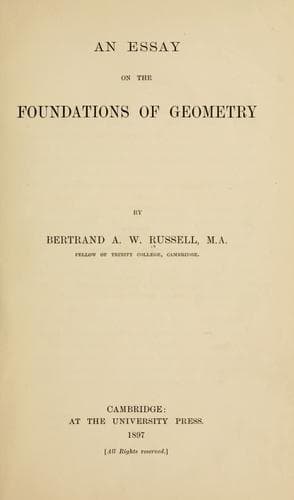
An essay on the foundations of geometryRussell, Bertrand
Philosophy
An essay on the foundations of geometry
Russell, Bertrand
Geometry -- Foundations
110. By which figures qualitatively indistinguishable from a
given figure are obtained 122
111. Anharmonic ratio may and must be descriptively defined 122
112. The quadrilateral construction is essential to the
projective definition of points, 123
113. And can be projectively defined, 124
114. By the general principle of projective transformation 126
115. The principle of duality is the mathematical form of a
philosophical circle, 127
116. Which is an inevitable consequence of the relativity of
space, and makes any definition of the point contradictory 128
117. We define the point as that which is spatial, but contains
no space, whence other definitions follow 128
118. What is meant by qualitative equivalence in Geometry? 129
119. Two pairs of points on one straight line, or two pairs of
straight lines through one point, are qualitatively equivalent 129
120. This explains why _four_ collinear points are needed, to give
an intrinsic relation by which the fourth can be descriptively
defined when the first three are given 130
121. Any two projectively related figures are qualitatively
equivalent, i.e. differ in no non-quantitative conceptual
property 131
122. Three axioms are used by projective Geometry, 132
123. And are required for qualitative spatial comparison, 132
124. Which involves the homogeneity, relativity and passivity
of space 133
125. The conception of a form of externality, 134
126. Being a creature of the intellect, can be dealt with by
pure mathematics 134
127. The resulting doctrine of extension will be, for the moment,
hypothetical 135
128. But is rendered assertorical by the necessity, for
experience, of some form of externality 136
129. Any such form must be relational 136
130. And homogeneous 137
131. And the relations constituting it must appear infinitely
divisible 137
132. It must have a finite integral number of dimensions, 139
133. Owing to its passivity and homogeneity 140
134. And to the systematic unity of the world 140
135. A one-dimensional form alone would not suffice for
experience 141
Public-domain text, read in full here on John Shaqi.
Reviews
Reviews
No reviews yet
Be the first to share your thoughts on this work.
Join the Discussion
Join the discussion
Sign in to leave a comment or review.
Sign InorCreate an account