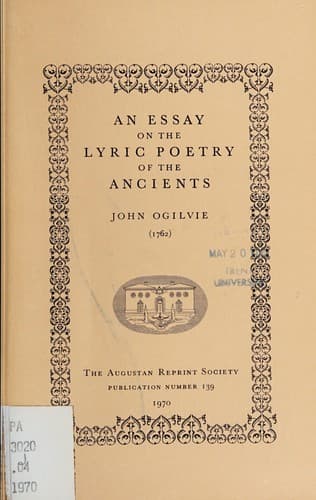
An Essay on the Lyric Poetry of the AncientsOgilvie, John
History
An Essay on the Lyric Poetry of the Ancients
Ogilvie, John
Classical poetry -- History and criticism
From this account of the different manners, in which the faculties of
the mind exert themselves in the sphere of competition, your Lordship
will immediately observe, that the Poet who attempts to combine distant
ideas, to catch remote allusions, to form vivid and agreeable pictures;
is more apt from the very nature of his profession to set up a _false
standard_ of _excellence_, than the cool and dispassionate Philosopher
who proceeds deliberately from position to argument, and who employs
Imagination only as the Handmaid of a superior faculty. Having gone thus
far, like persons who have got into a track from which they cannot
recede, we may venture to proceed a step farther; and affirm that the
_Lyric Poet_ is exposed to this hazard more nearly than any other, and
that to prevent him from falling into the extreme we have mentioned,
will require the exercise of the closest attention.
That I may illustrate this observation as fully as the nature of the
subject will permit, it will be expedient to enquire into the end which
Lyric Poetry proposeth to obtain, and to examine the original standards
from which the rules of this art are deduced.
Aristotle, who has treated of poetry at great length, assigns two causes
of its origin,--_Imitation_ and Harmony; both of which are natural to
the human mind[3]. By Imitation he understands, “whatever employs means
to represent any subject in a natural manner, whether it hath a real or
imaginary existence[4].” The desire of imitating is originally stamped
on the mind, and is a source of perpetual pleasure. “Thus” (says the
great Critic) “though the figures of wild beasts, or of dead men, cannot
be viewed as they naturally are without horror and reluctance; yet the
Imitation of these in painting is highly agreeable, and our pleasure is
augmented in proportion to that degree of resemblance which we conceive
to subsist betwixt the Original and the Copy[5].” By Harmony he
understands not the numbers or measures of poetry only, but that music
of language, which when it is justly adapted to variety of sentiment or
description, contributes most effectually to unite the pleasing with the
instructive[6]. This indeed seems to be the opinion of all the Ancients
who have written on this subject. Thus Plato says expressly, that those
Authors who employ numbers and images without music have no other merit
than that of throwing prose into measure[7].
[Footnote 3: Εοικασι δε γεννησαι μεν ὁλως την Ποιητικην, αιτιαι
δυο και αυται φυσικαι. Το μιμεισθαι συμφυτον τοις ανθρωποις, &c.
Και Ἁρμονια και ρυθμος εξ αρχης οἱ πεφυκοτες προς αυτα μαλιστα
κατα μικρον προαγοντες εγεινησαν την Ποιησιν‧ Arist. Poet. c. 4.]
[Footnote 4: The Reader of curiosity may see this subject
particularly discussed in Dacier’s Remarks on the Poeticks of
Aristotle, c. 4.]
Public-domain text, read in full here on John Shaqi.
Reviews
Reviews
No reviews yet
Be the first to share your thoughts on this work.
Join the Discussion
Join the discussion
Sign in to leave a comment or review.
Sign InorCreate an account