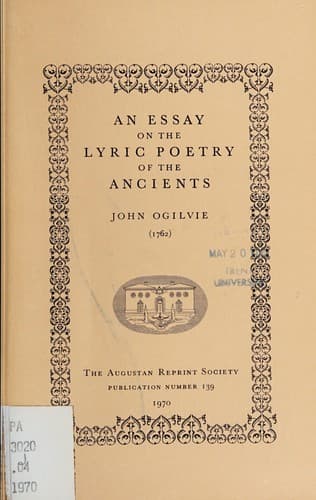
An Essay on the Lyric Poetry of the Ancients — John Shaqi
An Essay on the Lyric Poetry of the AncientsOgilvie, John
History
An Essay on the Lyric Poetry of the Ancients
Ogilvie, John
Classical poetry -- History and criticism
[Footnote 5: Ἁ γαρ αυτα λυπηρως ὁρωμεν, τουτων τας εικωνας τας
μαλιστα ηκριβωμενας, χαιρομεν θεωρουντες, οἱτινες θηρεων τε μορφας
των αγριοτατων και νεκρων, &c. Poet. c. 4.]
[Footnote 6: Τα γαρ μετρα ὁτι μοιρον των ρυθμων εστι, φανερον. Ub.
sup.]
[Footnote 7: Ρυθμον μεν και σχηματα μελους χωρις λογους ψιλους εις
μετρα τιθεντες. The persons who do this, he compares to Musicians.
Μελος δε αυ και ρυθμους ανευ ρημα{των} ψιλη κιθαριξει τε και
αυλησει προσχρωμενοι. Plat. de Legib. Lib. XI.]
You will no doubt be of opinion, my Lord, upon reflecting on this
subject, that Poetry was originally of an earlier date than Philosophy,
and that its different species were brought to a certain pitch of
perfection before that Science had been cultivated in an equal degree.
Experience informs us on every occasion, that Imagination shoots forward
to its full growth, and even becomes wild and luxuriant, when the
reasoning Faculty is only beginning to open, and is wholly unfit to
connect the series of accurate deduction. The information of the senses
(from which Fancy generally borrows her images) always obtains the
earliest credit, and makes for that reason the most lasting impressions.
The sallies of this irregular Faculty are likewise abrupt and
instantaneous, as they are generally the effects of a sudden impulse
which reason is not permitted to restrain. As therefore we have already
seen, that the desire of imitating is _innate_ to the mind (if your
Lordship will permit me to make use of an unphilosophical epithet) and
as the first inhabitants of the world were employed in the culture of
the field, and in surveying the scenery of external Nature, it is
probable that the first rude draughts of Poetry were extemporary
effusions, either descriptive of the scenes of pastoral life, or
extolling the attributes of the Supreme Being. On this account Plato
says that Poetry was originally Ενθεος Μιμησις[8], or an inspired
imitation of those objects which produced either pleasure or admiration.
To paint those objects which produced pleasure was the business of the
pastoral, and to display those which raise admiration was the task
consigned to the Lyric Poet. --To excite this passion, no method was so
effectual as that of celebrating the perfections of the Powers who were
supposed to preside over Nature. The Ode therefore in its first
formation was a song in honour of these Powers[9], either sung at solemn
festivals or after the days of Amphion who was the inventor of the Lyre,
accompanied with the musick of that instrument. Thus Horace tells us,
_Musa dedit fidibus Divos, puerosque Divorum_[10],
The Muse to nobler subjects tun’d her lyre,
Gods, and the sons of Gods her song inspire. FRANCIS.
[Footnote 8: Plat. Io.]
Public-domain text, read in full here on John Shaqi.
Reviews
Reviews
No reviews yet
Be the first to share your thoughts on this work.
Join the Discussion
Join the discussion
Sign in to leave a comment or review.
Sign InorCreate an account