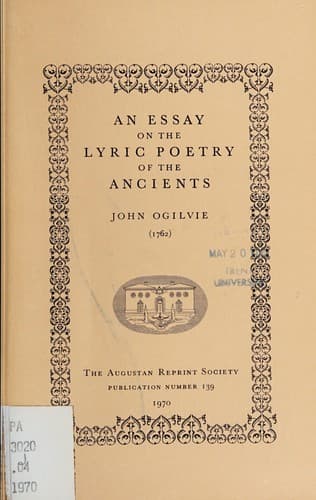
An Essay on the Lyric Poetry of the AncientsOgilvie, John
History
An Essay on the Lyric Poetry of the Ancients
Ogilvie, John
Classical poetry -- History and criticism
Of all his books, there is not one which, as a whole, can be
expected to please the general reader. Noble sentiments, brilliant
conceptions, and poetic graces, may be culled in profusion from the
mass; but there is no one production in which they so predominate,
(if we except some of the minor pieces,) as to induce it to be
selected for a happier fate than the rest. Had the same talent which
Ogilvie threw away on a number of objects, been concentrated on one,
and that one chosen with judgment and taste, he might have rivalled
in popularity the most renowned of his contemporaries.[1]
The present letters reproduced here, along with the two volumes of his
_Philosophical and Critical Observations on Composition_ (London, 1774),
are Ogilvie’s major contributions to literary criticism. The remainder
of his work, which is extensive, is divided almost equally between
poetry and theological inquiry. At least one of his poems, “The Day of
Judgment” (1758), was known to Churchill, Boswell, and Johnson, but
unfortunately for Ogilvie’s reputation Johnson “saw nothing” in it.[2]
I shall attempt no special pleading for Ogilvie here; he is and shall
remain a minor neoclassic theorist. At the very least, however, it can
be said that his methods are reasonably various and that, while his
general critical assumptions are not unique, his control is strong. The
fluidity with which he moves from one related position to another
indicates a mind well informed by the critical tenets of his own time.
If he does not surprise, he is nevertheless an interesting and worthy
exemplar of the psychological tradition in later eighteenth-century
criticism; and his historicism provides, and is intended to provide,
an extensive field for the workings of psychological inquiry.
Public-domain text, read in full here on John Shaqi.
Reviews
Reviews
No reviews yet
Be the first to share your thoughts on this work.
Join the Discussion
Join the discussion
Sign in to leave a comment or review.
Sign InorCreate an account