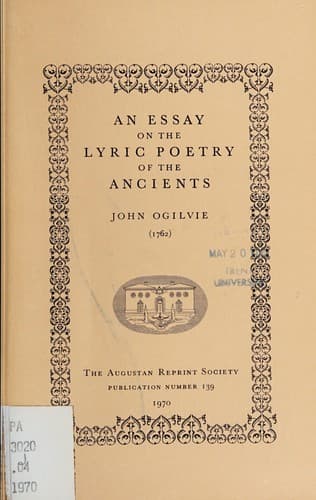
An Essay on the Lyric Poetry of the AncientsOgilvie, John
History
An Essay on the Lyric Poetry of the Ancients
Ogilvie, John
Classical poetry -- History and criticism
Thus his initial inquiry, in the first letter, into the Aristotelian
principles of imitation and harmony establishes each as “natural” to the
mind, and his distinctions between the separate provinces of reason and
imagination are for the purpose of assigning to each its separate
intellectual capacities. From these orderings follows his idea that
poetry is of an earlier date than philosophy, the product of an
irregular faculty, less governable than the reason and of swifter
development. In turn, these assumptions lead into a form of historical
primitivism in which the products of the first poets were “extemporary
effusions,” rudely imitative of pastoral scenes or celebratory of the
divine being. Thus the first generic distinction Ogilvie makes is
between pastoral poetry and lyric; the function of the former is to
produce pleasure, the latter to raise admiration of the powers presiding
over nature. As poetry is more natural to the young mind than
philosophy, so is the end of pastoral poetry more easily achieved than
that of the lyric. The difference resides essentially in Ogilvie’s
notion that the pastoral poet contemplates “external objects,” while the
lyric poet regards that which is not immediately available to the senses
and consequently requires a more exuberant invention. What follows upon
these reflections is a rather ingenious form of historical progressivism
in which the civilizing powers of the poet provide the principal
justification for lyric poetry. At work in Ogilvie’s thought is a
conception of the mythopoeic function of the earliest poets whose names
have come down to us. Such poets, however, did not create their mythos,
but imbibed it from the earlier Egyptian civilization and formed
disguised allegorical poems. Here the instructive function of the first
poets is related to the enlarging of the reader’s imagination, so that
Ogilvie’s rather shrewd defense of lyric poetry is based upon the
civilizing effects of imaginative appeal.
The infancy of poetry is related to the infancy of civilization, and the
analogical possibilities of the one to the other sustain his argument at
every point. If his historicism is dubious, his discourse is neatly
illustrative of a neoclassic critical method and of the kind of
psychological assumptions upon which such arguments could proceed. From
the rather copious use of allegory and metaphor, as civilizing
instruments, Ogilvie traces the rise of the religious fable as part of
the inevitable sequence of imaginative development. To account,
therefore, for the irregularity of the ode, for the “enthusiasm,
obscurity and exuberance” (p. xxiv) which continue to characterize it,
he refers to its anciently established character, a character not
susceptible to amelioration by speculative rules. He allows, however,
that both the “Epopee” (or epic) and the drama were gradually improved,
and the informing principle of his historical progressivism is again
patent.
Public-domain text, read in full here on John Shaqi.
Reviews
Reviews
No reviews yet
Be the first to share your thoughts on this work.
Join the Discussion
Join the discussion
Sign in to leave a comment or review.
Sign InorCreate an account