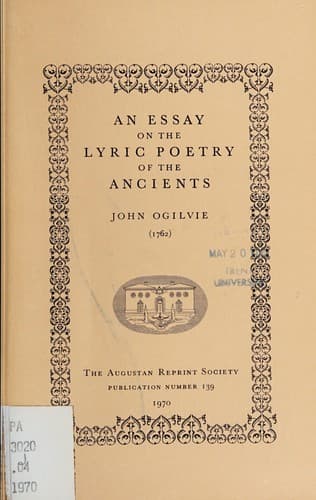
An Essay on the Lyric Poetry of the AncientsOgilvie, John
History
An Essay on the Lyric Poetry of the Ancients
Ogilvie, John
Classical poetry -- History and criticism
Such, my Lord, was the character of the first Lyric Poets, and such were
the subjects upon which they exercised invention. We have seen, in the
course of this short detail, that these Authors attempted to civilize a
barbarous people, whose imagination it was necessary to seize by every
possible expedient; and upon whom chastised composition would have
probably lost its effect, as its beauties are not perceptible to the
rude and illiterate. That they employed this method principally to
instruct their countrymen is more probable, when we remember that the
rudiments of learning were brought from Ægypt, a country in which Fable
and Allegory remarkably predominated[30]. By conversing with this
people, it is natural to suppose that men of impetuous imaginations
would imbibe their manner, and would adopt that species of composition
as the most proper, which was at the same time agreeable to their own
inclination, and authorised as expedient by the example of others.
From the whole, my Lord, we may conclude with probability, that the
Greek Hymn was originally a loose allegorical Poem, in which Imagination
was permitted to take its full career, and sentiment was rendered at
once obscure and agreeable, by being screened behind a veil of the
richest poetic imagery.
[Footnote 30: This allegorical learning was so much in use among
the Ægyptians, that the Disciples of a Philosopher were bound by
an oath. Εν ὑποκρυφοις ταυτα εχειν‧ και τοις απαιδευτοις και
αμνητοις μη μεταδεδιναι. Vid. Seld. de Diis Syr.]
The loose fragments of these early writers which have come down to our
times, render this truth as conspicuous as the nature of the subject
will permit. A Theogony, or an account of the procession of fabulous
Deities, was a theme on which Imagination might display her inventive
power in its fullest extent. Accordingly Hesiod introduces his work with
recounting the genealogy of the Muses, to whom he assigns “an apartment
and attendants, near the summit of snowy Olympus[31].” These Ladies, he
tells us, “came to pay him a visit, and complimented him with a scepter
and a branch of laurel, when he was feeding his flock on the mountain of
Helicon[32].” Some tale of this kind it was usual with the Poets to
invent, that the vulgar in those ages of fiction and ignorance might
consider their persons as sacred, and that the _offspring of their
imaginations_ might be regarded as _the children of Truth_.
[Footnote 31: ---- Ἡσιν αοιδη
Μεμβλεται, εν στηθεσσιν ακηδεα θυμον εχουσαις
Τυτθον απ’ ακροτατης κορυφης νιφεντος Ολυμπου.
Ενθα σφιν λιπαροι τε χοροι, και δωματα καλα.
Theog. a lin. 61.]
[Footnote 32:
Ὡς εφασαν Ηουραι Μεγαλου Διος αρτιεπειαι·
Και μοι σκεπτρον εδον, δαφνης εριθελεος οζον
Δρεψασθαι θηητον· επενευσαν δε μοι αυδην &c.
Theogon. l. 30.]
Public-domain text, read in full here on John Shaqi.
Reviews
Reviews
No reviews yet
Be the first to share your thoughts on this work.
Join the Discussion
Join the discussion
Sign in to leave a comment or review.
Sign InorCreate an account