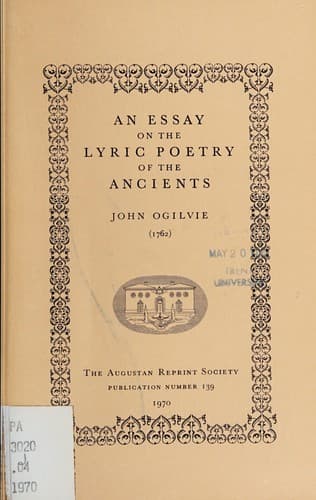
An Essay on the Lyric Poetry of the AncientsOgilvie, John
History
An Essay on the Lyric Poetry of the Ancients
Ogilvie, John
Classical poetry -- History and criticism
From the same licentious use of Allegory and Metaphor sprung the Fables
of the wars of the Giants, of the birth and education of Jupiter, of the
dethroning of Saturn, and of the provinces assigned by the Supreme to
the Inferior Deities; all of which are subjects said to have been
particularly treated by Orpheus[33]. The love of Fable became indeed so
remarkably prevalent in the earliest ages, that it is now impossible in
many instances to distinguish real from apparent truth in the History of
these times, and to discriminate the persons who were useful members of
society, from those who exist only in the works of a Poet, whose aim was
professedly to excite Admiration. Thus every event of importance was
disfigured by the colouring of poetic narration, and by ascribing to one
man the separate actions which perhaps were performed by several persons
of one name[34], we are now wholly unable to disentangle truth from a
perplexed and complicated detail of real and fictitious incidents.
[Footnote 33: Orph. Hym. in Apollon. Rhod.]
[Footnote 34: Of this, History furnisheth many examples. When one
man made an eminent figure in any profession, the actions of other
persons who had the same name were ascribed to him; and it was
perhaps partly for this reason that we find different cities
contending for the honour of giving birth to men of Genius, or
eminence. Callimachus in his Hymn to Jupiter makes an artful use
of this circumstance.
Εν δοιη μαλα θυμος· επει γενος αμφεριστον.
Ζευ σε μεν Ι’ δαιοισιν εν ουρεσι φασι γενεσθαι
Ζευ σε δ’ εν Αρκαδιη· ποτεροι Πατερ εψευσαντο
Κρητες αει ψευσται· και γαρ ταφον, ὡ ανα σειο
Κρητες ετεκτηναντο· συ δ’ ου θανες· εσσι γαρ αιει.
Callim. p. 4.]
It appears likewise from these shreds of antiquity, that the subjects of
the Hymn were not sufficiently limited, as we sometimes find one of them
addressed to several Deities, whose different functions recurring
constantly to the mind must have occasioned unavoidable obscurity[35].
The Poet by this means was led into numberless digressions, in which the
remote points of connection will be imperceptible to the reader, who
cannot place himself in some situation similar to that of the Writer,
and attend particularly to the character and manners of the period at
which he wrote.
[Footnote 35: Thus Theocritus.
Ὑμνεομες Ληδας. Τε και αιγιοχω Διος Ὑιω,
Καστορα και φοβερον Πολυδευκεα πυξ ερεθιζεν
Ὑμνεομες και Δις, και το Τριτον.]
Public-domain text, read in full here on John Shaqi.
Reviews
Reviews
No reviews yet
Be the first to share your thoughts on this work.
Join the Discussion
Join the discussion
Sign in to leave a comment or review.
Sign InorCreate an account