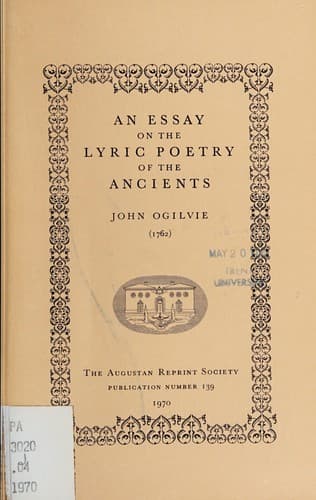
An Essay on the Lyric Poetry of the AncientsOgilvie, John
History
An Essay on the Lyric Poetry of the Ancients
Ogilvie, John
Classical poetry -- History and criticism
Accustomed as your Lordship has been to survey the improved manners of
an enlightned age, you will contemplate with pleasure an happier aera in
the progression of Science, when the Ode from being confined wholly to
fictitious Theology, was transposed to the circle of Elegance and the
Graces. Such is its appearance in the writings ot Anacreon, of Horace,
and in the two fragments of Sappho.
Anacreon was nearly contemporary with that Onomacritus, whom we have
mentioned as the Author of those poems which are ascribed to Orpheus.
He flourished between the 60th and the 70th Olympiad. His pieces are the
offspring of genius and indolence. His subjects are perfectly suited to
his character. The devices which he would have to be carved upon a
silver cup are extremely ingenious.
---- Διος γονον
Βακχον Ευιον ἡμιν.
Μυστιν αματε Κυπριν
Ὑμεναιοις κροτουσαν.
Και Εροτας αποπλους
Και χαριτας γελωσας, &c.[36]
---- The race of Jove,
Bacchus whose happy smiles approve;
The Cyprian Queen, whose gentle hand
Is quick to tye the nuptial band;
The sporting Loves unarm’d appear,
The Graces loose and laughing near.
[Footnote 36: Anac. Carm. p. 35.]
Sweetness and natural elegance characterise the writings of this Poet,
as much as carelessness and ease distinguished his manners. In some of
his pieces there is exuberance and even wildness of imagination, as in
that particularly which is addressed to a young girl, where he wishes
alternately to be transformed into a mirror, a coat, a stream,
a bracelet, and a pair of shoes, for the different purposes which he
recites[37]. This is meer sport and wantonness, and the Poet would
probably have excused himself for it, by alledging that he took no
greater liberties in his own sphere than his predecessors of the same
profession had done in another. His indolence and love of ease is often
painted with great simplicity and elegance[38], and his writings abound
with those beautiful and unexpected turns which are characteristic of
every species of the Ode[39].
[Footnote 37: Anac. p. 87.]
[Footnote 38: This appears remarkably in that piece, where he
gives so ingenuous a character of himself.
Ὁν μοι μελει Γυγου
Του Σαρδεων Ανακτος
Το σημερον μελει μοι. p. 28.]
[Footnote 39: The reader will find a striking example of this
beauty, in the Ode addressed to a swallow, where he runs a
comparison betwixt the liberty of that bird and his own bondage.
Συ μεν φιλη χελιδων, &c. p. 60.]
Public-domain text, read in full here on John Shaqi.
Reviews
Reviews
No reviews yet
Be the first to share your thoughts on this work.
Join the Discussion
Join the discussion
Sign in to leave a comment or review.
Sign InorCreate an account