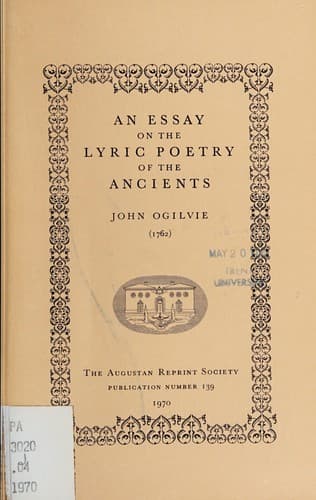
An Essay on the Lyric Poetry of the AncientsOgilvie, John
History
An Essay on the Lyric Poetry of the Ancients
Ogilvie, John
Classical poetry -- History and criticism
Your Lordship, without the testimony of experience, would hardly believe
that a species of composition which derived its origin from, and owed
its peculiarities to the circumstances we have mentioned, could have
been considered in an happier æra as a pattern worthy the imitation of
cultivated genius, and the perusal of a polished and civilized people.
One is indeed ready to conclude, at the first view, that a mode of
writing which was assumed for a particular purpose, and was adopted to
the manners of an illiterate age, might at least have undergone
considerable alterations in succeeding periods, and might have received
improvements proportioned to those which are made in other branches of
the same art. But the fact is, that while the other branches of poetry
have been gradually modelled by the rules of criticism, the Ode hath
only been changed in a few external circumstances, and the enthusiasm,
obscurity and exuberance, which characterised it when first introduced,
continue to be ranked among its capital and discriminating excellencies.
To account for this phenomenon, my Lord, I need only remind your
Lordship of a truth which reflexion has, no doubt, frequently
suggested;--that the rules of criticism are originally drawen, not from
the speculative idea of perfection in an art, but from the work of that
Artist to whom either merit or accident hath appropriated the most
established character. From this position it obviously follows, that
such an art must arrive at once to its highest perfection, as the
attempts of succeeding performers are estimated not by their own
intrinsic _value_ or demerit, but by their conformity to a standard
which is previously set before them. It hath happened fortunately for
the republic of letters, that the two higher species of poetry are
exempted from the bad consequences which might have followed an exact
observation of this rule. An early and perfect standard was settled to
regulate the Epopee, and the Drama was susceptible of _gradual
improvement_, as Luxury augmented the subjects, and decorated the
machinery of the theatre. We have already seen that Lyric Poetry was not
introduced with the advantages of the former, and reflection must
convince us, that it is not calculated to gain the slow and
imperceptible accessions of the latter. We may observe however in the
general, that as the opinions of the bulk of mankind in speculative
matters are commonly the result of accident rather than the consequences
of reflection, so it becomes extremely difficult, if not impossible, in
some instances to point out a defect in an _established model_ without
incurring the censure of the multitude. Such, my Lord, is the nature of
man, and so trifling and capricious are the circumstances upon which his
sentiments depend.
Public-domain text, read in full here on John Shaqi.
Reviews
Reviews
No reviews yet
Be the first to share your thoughts on this work.
Join the Discussion
Join the discussion
Sign in to leave a comment or review.
Sign InorCreate an account