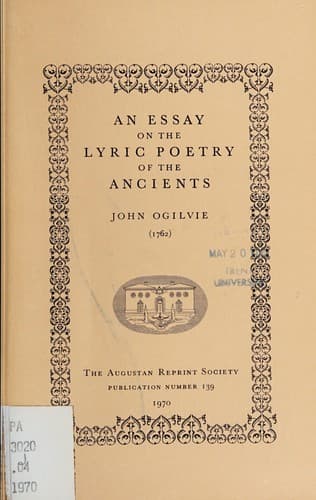
An Essay on the Lyric Poetry of the AncientsOgilvie, John
History
An Essay on the Lyric Poetry of the Ancients
Ogilvie, John
Classical poetry -- History and criticism
Though the influence of imagination on every species of Poetry is so
obvious, as not to stand in need of illustration, yet we must observe at
the same time, that this power is exerted in different degrees[56], as
the Poet is led by the nature of that subject to which his Genius hath
received the most remarkable bias. Thus the simple beauties of the
Eclogue would appear in the same light, when transposed to the Epopee,
as plants brought to forced vegetation in a Green-house must do to those
who have seen them flourishing in their native soil, and ripened by the
benignity of an happier climate. In the one case they are considered as
unnatural productions, whose beauty is surpassed by the Natives of the
soil; in the other they are regarded as just and decent ornaments, whose
real excellence is properly estimated. The same remark may be applied
indiscriminately to all the other branches of this art. Though they are
originally the offspring of _one Parent_, yet there are certain
characteristic marks, by which a general resemblance is fully
distinguished from perfect similarity.
[Footnote 56: Una cuique proposita lex, suus decor est. Habet
tamen omnis Eloquentia aliquid commune. Quintil. Instit. Lib. X
c. II.]
It is necessary to observe in general on this subject, that whatever
degree of superiority the reasoning Faculty ought ultimately to possess
in the sphere of Composition, we are not to consider this Power as
acting the same part in the work of a Poet, which it should always act
in that of a Philosopher. In the performance of the latter, an appeal to
reason is formally stated, and is carried on by the process of connected
argumentation; whereas in that of the former the Judgment is
_principally_ employed in the disposition of materials[57]. Thus the
Philosopher and the Poet are equally entitled to the character of
judicious, when the arguments of the one are just and conclusive, and
when the images of the other are apposite and natural.
Public-domain text, read in full here on John Shaqi.
Reviews
Reviews
No reviews yet
Be the first to share your thoughts on this work.
Join the Discussion
Join the discussion
Sign in to leave a comment or review.
Sign InorCreate an account