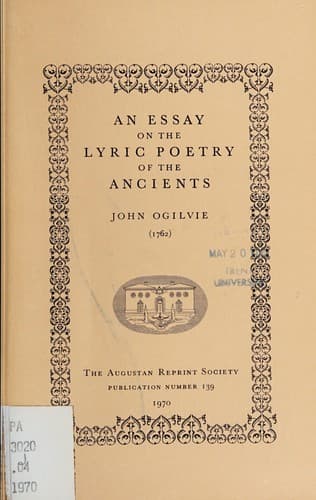
An Essay on the Lyric Poetry of the AncientsOgilvie, John
History
An Essay on the Lyric Poetry of the Ancients
Ogilvie, John
Classical poetry -- History and criticism
[Footnote 57: In the Epopee we judge of the Genius of the Poet,
by the variety and excellence of those materials with which
Imagination enricheth his subject. His Judgment appears in the
disposition of particular images, and in the general relation
which every subordinate part bears to the principal action of the
Poem. Thus it is the business of this Faculty, as an ingenious
Critic says, “Considerer comme un corps qui no devoit pas avoir
des membres de natures differentes, et independens les uns des
autres.” Bossu du Poem. Epiq. Liv. II. ch. 2. It is true indeed,
that Tragedy is rather an address to the passions than to the
imagination of mankind. To the latter however we must refer all
those finer strokes of poetic painting, which actuate so forcibly
the affections and the heart. We may, in short, easily conceive
the importance of a warm imagination to the Dramatic Poet, by
reflecting upon the coldness and indifference with which we peruse
those pieces, which are not enlivened by the sallies of this
Faculty when it is properly corrected. Though we must acknowledge
that Passion seldom adopts the images of description, yet it must
be owned at the same time, that neither can a person who wants
imagination feel with sensibility the impulse of the Passions.
A Poet may even merit a great encomium who excels in painting the
effects, and in copying the language of Passion, though the
Disposition of his work may be otherwise irregular and faulty.
Thus Aristotle says of a celebrated dramatic Poet, Και Ὁ Ευριπιδης
ει και τα αλλα μη ευ οικονομει, αλλα ΤΡΑΓΙΚΩΤΑΤΟΣ γε των Ποιητων
φαινεται. De Poet. c. 13. Upon the whole therefore, Didactic or
Ethical Poetry is the only species in which Imagination acts but a
secondary part, because it is unquestionably the business of
reason to fix upon the most forcible arguments, as well as to
throw them into the happiest disposition. We have seen however,
in some late performances, what superior advantages this branch of
the Art receives from a just and proper infusion of the poetic
idioms.]
Public-domain text, read in full here on John Shaqi.
Reviews
Reviews
No reviews yet
Be the first to share your thoughts on this work.
Join the Discussion
Join the discussion
Sign in to leave a comment or review.
Sign InorCreate an account