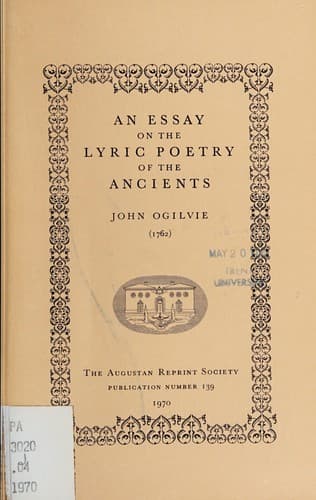
An Essay on the Lyric Poetry of the Ancients — John Shaqi
An Essay on the Lyric Poetry of the AncientsOgilvie, John
History
An Essay on the Lyric Poetry of the Ancients
Ogilvie, John
Classical poetry -- History and criticism
Admiration is a passion which can never be excited in any person, unless
when there is something great and astonishing, either in the general
disposition of a work or in some of the separate members of which it is
formed. Thus we admire a whole piece, when we observe that the parts
which compose it are placed in a striking and uncommon combination, and
we even consider one happy stroke as an indication of genius in the
Artist. It frequently happens that the subject of a Poem is of such a
nature, as that its most essential members cannot be set in any light
distinct from that in which custom and experience has led us to consider
them. Thus when the Poet addressed an Hymn to Jupiter, Diana, or Apollo,
he could not be ignorant that his readers were well apprised of the
general manner, in which it was necessary to treat of these Personages,
and that they would have been offended, if he had presumed to differ in
any material point from the opinions handed down by traditionary
evidence. It was therefore necessary, that the Poet should manage a
subject of this kind in the same manner as Rubens and Caypel have
painted the Crucifixion, by either varying _the attitude_ of the
principal object to make it more sublime and admirable, or by rendering
some _inferior figure_ picturesque and animated which had escaped the
notice of his Predecessors. When therefore a sublime object is not shown
in some great and uncommon point of view, the Poet sinks in our esteem
as much as he would have risen in it, if we had found his Genius equal
to his Ambition.
As I have already borrowed one illustration from painting, permit me to
recall to your Lordship’s memory, that noble figure by which the Church
of Rome permitted Raphael to represent the Eternal Father, a figure
which has always been considered as one of the greatest ornaments of the
galleries of the Vatican[62]. Any person may conclude that the
difficulty of succeeding in this great attempt, must have bore some
proportion to the _temerity_ (shall we call it) of venturing to design
it. If this celebrated Artist had failed of throwing into that figure an
Air wholly extraordinary, his Design would either have been considered
as rash, or his imagination censured as deficient.
[Footnote 62: Raphael is said to have stolen the expression of
this figure from Michael Angelo, who was at work on the same
subject in another part of the Vatican. We are indebted for this
curious anecdote to the ingenious Abbe du Bos. See his Reflex.
Crit. sur la Poes. et la Peint. Vol. II.]
On the contrary, the Poet who chuseth a more unpromising subject, and
displays an unexpected fertility of invention in his manner of treating
it, is admired as an Original Genius, and the perusal of his work
excites in our mind the most agreeable mixture of surprize and pleasure.
Public-domain text, read in full here on John Shaqi.
Reviews
Reviews
No reviews yet
Be the first to share your thoughts on this work.
Join the Discussion
Join the discussion
Sign in to leave a comment or review.
Sign InorCreate an account