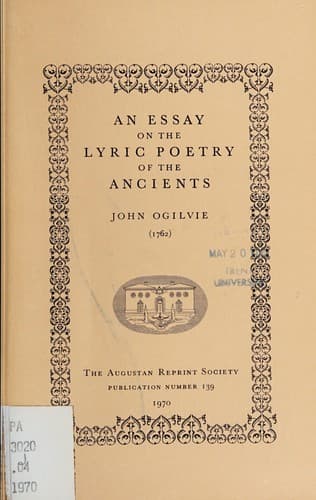
An Essay on the Lyric Poetry of the Ancients — John Shaqi
An Essay on the Lyric Poetry of the AncientsOgilvie, John
History
An Essay on the Lyric Poetry of the Ancients
Ogilvie, John
Classical poetry -- History and criticism
As to the first, I need not tell your Lordship, that whatever Art
proposeth as an ultimate end to excite Admiration, must owe its
principal excellence to that Faculty of the mind which delights to
contemplate the sublime and the wonderful. This indeed may be called the
sphere, in which Imagination peculiarly predominates. When we attempt,
even in the course of conversation, to paint any object whose
magnificence hath made a strong impression upon the memory, we naturally
adopt the boldest and most forcible epithets we can think of, to convey
our own idea as compleatly as possible to the mind of another. We are
prompted by a powerful propensity to retouch our description again and
again, we select the most apposite images to animate our expression;
in short, we fall without perceiving it, into the stile and figures of
poetry. If then Admiration produceth such an effect upon the mind in the
more common occurrences of life, we may conceive the superior influence
which it must have upon the imagination of a Poet, when it is wound up
to the highest pitch, and is placing a great object in every point of
light by which its excellence may most conspicuously appear. It will at
least be obvious, that in such a situation the feelings of the heart
must be more intensely animated than in any other, not only because
Genius is supposed to be the Parent of Sensibility, but as the person
who is possessed of this quality exerts the full force of his talents
and art to produce one particular effect. He endeavours (as Longinus
expresseth it) “not to be seen himself, but to place the idea which he
hath formed before the very eye of another[60].”
[Footnote 60: De Sublim. Sect. 32.]
It is a common mistake among people who have not examined this subject,
to suppose that a Poet may with greater ease excite Admiration when his
theme is sublime, than when it is such as we have been more accustomed
to contemplate[61]. This opinion is indeed plausible at the first view,
because it may be said that we go half-way to meet that Author, who
proposeth to reach an end by means which have an apparent probability to
effectuate it; but it will appear upon reflection, that this very
circumstance, instead of being serviceable, is in reality detrimental to
the Poet.
[Footnote 61: The reader will observe, that Admiration through
the whole of this part of the Essay is taken in the largest sense,
as including a considerable degree of wonder, which is however a
distinct feeling. The former is excited principally by the
sublime; the latter by the new and uncommon. These feelings are
united, when a subject of moderate dignity is treated in a sublime
manner. See the Essay, p. 47, 48.]
Public-domain text, read in full here on John Shaqi.
Reviews
Reviews
No reviews yet
Be the first to share your thoughts on this work.
Join the Discussion
Join the discussion
Sign in to leave a comment or review.
Sign InorCreate an account