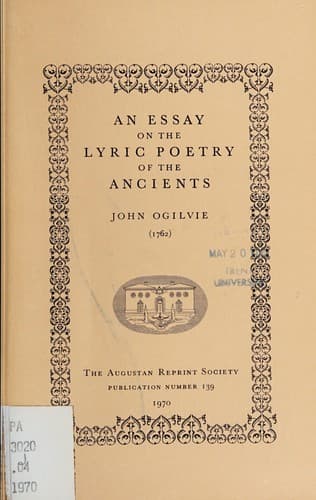
An Essay on the Lyric Poetry of the AncientsOgilvie, John
History
An Essay on the Lyric Poetry of the Ancients
Ogilvie, John
Classical poetry -- History and criticism
I have mentioned these examples, as they shew the light in which a great
object will be contemplated by a man of genius; and as the reader will
observe that our admiration is not merely excited by the dignity of the
theme, but that it results from the great and uncommon circumstances
which are happily thrown into the description. Pindar, no doubt, found
it a much easier task to raise this passion in favour of Theron, whom he
artfully introduceth to the reader’s attention, after enquiring of his
Muse what God or what distinguished Heroe he should attempt to
celebrate[66].
[Footnote 66: This is one of the most artful and best conducted of
Pindar’s Odes. The introduction is abrupt and spirited, and the
Heroe of the Poem is shown to great advantage.
Αναξιφορμιγγες ὑμνοι
τινα θεον, τιν’ ἡροα,
τινα δ’ ανδρα κελαδησομεν;
ητοι πισα μεν Διος‧
Ολυμπιαδα δ’ εστα-
σεν Ηρακλεης, &c.
Θηρωνα δε τετραοριας
ἑνεκα νεκαφορου
γεγωνητεον, οπε &c. Pind. Olym. 2da.]
It is however obvious, from what hath been advanced on this subject,
that whatever may be the nature of the theme on which the Poet insists,
it is the business of Fancy to enliven the whole piece with those
natural and animating graces which lead us to survey it with admiration.
From the whole therefore it appears, that this Faculty of the mind
claims an higher share of merit in the competition of the Ode than in
any other species of Poetry; because in the other branches of this art
different ends may be obtained, and different expedients may be fallen
upon to gain them; but the most perfect kind of Lyric Poetry admits only
of that end, to the attainment of which fertility of Imagination is
indispensably requisite.
You will recollect, my Lord, a petition laid down in the beginning of
this Essay;--that “when Imagination is permitted to bestow the graces of
ornament indiscriminately, sentiments are either superficial, and thinly
scattered through a work, or we are obliged to search for them beneath a
load of superfluous colouring.” I shall now endeavour to evince the
truth of this reflection, by enquiring more particularly what are the
faults into which the Lyric Poet is most ready to be betrayed, by giving
a loose rein to that Faculty which colours and enlivens his composition.
It may be observed then in general, that we usually judge of the Genius
of a Lyric Poet by the variety of his _images_, the boldness of his
_transitions_, and the picturesque vivacity of his _descriptions_.
I shall under this head trouble your Lordship with a few reflections on
each of these considered separately.
Public-domain text, read in full here on John Shaqi.
Reviews
Reviews
No reviews yet
Be the first to share your thoughts on this work.
Join the Discussion
Join the discussion
Sign in to leave a comment or review.
Sign InorCreate an account