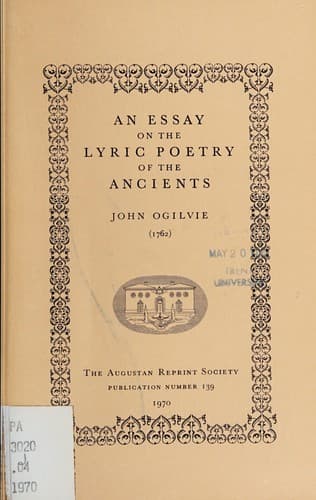
An Essay on the Lyric Poetry of the AncientsOgilvie, John
History
An Essay on the Lyric Poetry of the Ancients
Ogilvie, John
Classical poetry -- History and criticism
By the Images which are employed in the Ode, I mean those illustrations
borrowed from _natural_ and often from _familiar_ objects, by which the
Poet either clears up an obscurity, or arrests the attention, and
kindles the imagination of his reader. These illustrations have very
distinct uses in the different species of poetic composition. The
greatest Masters in the Epopee often introduce metaphors, which have
only a general relation to the subject; and by pursuing these through a
variety of circumstances, they disengage the reader’s attention from the
principal object. This indeed often becomes necessary in pieces of
length, when attention begins to relax by following too closely one
particular train of ideas. It requires however great judgment in the
Poet to pursue this course with approbation, as he must not only fix
upon metaphors which in some points have a striking similarity to the
object illustrated, but even the digressive circumstances must be so
connected with it, as to exhibit a succession of sentiments which
resemble, at least remotely, the subject of his Poem[67]. It must be
obvious, at first view, that as the Lyric Poet cannot adopt this plea,
his metaphors will always have the happiest effect, when they correspond
to the object in such a manner, as to shew its compleat proportions in
the fullest point of view, without including foreign and unappropriated
epithets. This however is not the course which a Writer of imagination
will naturally follow, unless his judgment restrains the excursions of
that excentric faculty. He will, on the contrary, catch with eagerness
every image which Fancy enlivens with the richest colouring, and he will
contemplate the external beauty of his metaphor, rather than consider
the propriety with which it is applied as an illustration. It is
probably owing to this want of just attention to propriety, that the
first Lyric Poets have left such imperfect standards to the imitation of
posterity.
[Footnote 67: The reader will meet with many examples of this
liberty in the Iliad, some of which Mr. Pope has judiciously
selected in the notes of his translation. Milton, in the same
spirit, compares Satan lying on the lake of fire, to a Leviathan
slumbering on the coast of Norway; and immediately digressing from
the strict points of connection, he adds, “that the mariners often
mistake him for an island, and cast anchor on his side.” Par.
Lost, B. II. In this illustration it is obvious, that though the
Poet deviates from close imitation, yet he still keeps in view the
general end of his subject, which is to exhibit a picture of the
fallen Arch angel. See Par. Lost, B. I.]
Public-domain text, read in full here on John Shaqi.
Reviews
Reviews
No reviews yet
Be the first to share your thoughts on this work.
Join the Discussion
Join the discussion
Sign in to leave a comment or review.
Sign InorCreate an account