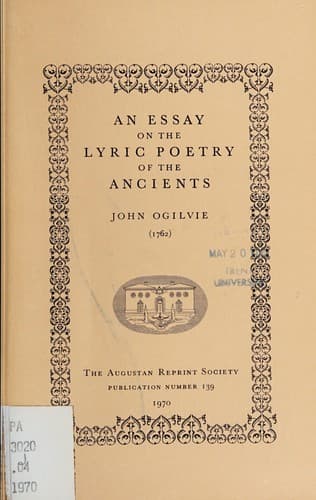
An Essay on the Lyric Poetry of the AncientsOgilvie, John
History
An Essay on the Lyric Poetry of the Ancients
Ogilvie, John
Classical poetry -- History and criticism
When we examine the works of later Poets among the Ancients, we find
that even those of them who are most exceptionable in other
circumstances, have yet in a great measure corrected this mistake of
their predecessors. In the lyric Odes of Euripides and Sophocles, the
metaphors made use of are generally short, expressive, and fitted to
correspond with great accuracy to the point which requires to be
illustrated[68]. Pindar is in many instances equally happy in the choice
of his images, which are frequently introduced with address, and produce
a very striking effect[69].
[Footnote 68: The reader may consider, as an example, of the
following verses of the Ode of Sophocles to the Sun.
Πολλα γαρ ὡστ’ ακαμαντος
η Νωτου η Βορεα τις
κυματα ευρει ποντω
βαντ’ επιοντα τ’ ιδοι
οὑτο δε τον καδμογενη
τρεφει‧ το δ’ αυξει βιοτου
πολυπονον ὡστε πελαγος
κρητιον. Soph. Trachin.]
[Footnote 69: Of this the reader will find a noble instance in
Pindar’s first Pythian Ode, where he employs from the verse
beginning ναυσιφορηταις δ’ αδρασεα, &c. to the end of the stanza,
one of the happiest and most natural illustrations that is to be
met with either in the works of Pindar, or in those of any Poet
whatever. The abrupt address to Phœbus, when he applies the
metaphor, is peculiarly beautiful.]
It is likewise necessary that the Poet should take care in the higher
species of the Ode, to assign to every object that precise degree of
colour, as well as that importance in the arrangement of sentiments
which it seems peculiarly to demand. The same images which would be
considered as capital strokes in some pieces can be admitted only as
secondary beauties in others; and we might call in question both the
judgment and the imagination of that Poet who attempts to render a faint
illustration adequate to the object, by clothing it with profusion of
ornament. A defect likewise either in the choice, or in the disposition,
of images, is conspicuous in proportion to the importance of the
subject, as well as to the nature of those sentiments with which it
stands in more immediate connection. It is therefore the business of the
Lyric Poet, who would avoid the censure of competing with inequality,
to consider the colouring of which particular ideas are naturally
susceptible, and to discriminate properly betwixt sentiments, whose
native sublimity requires but little assistance from the pencil of art,
and a train of thought which (that it may correspond to the former)
demands the heightening of poetic painting. The astonishing inequalities
which we meet with, even in the productions of unquestioned Genius, are
originally to be deduced from the carelessness of the Poet who permitted
his imagination to be hurried from one object to another, dwelling with
pleasure upon a favourite idea, and passing slightly over intermediate
steps, that he may catch that beauty which fluctuates on the gaze of
Expectation.
Public-domain text, read in full here on John Shaqi.
Reviews
Reviews
No reviews yet
Be the first to share your thoughts on this work.
Join the Discussion
Join the discussion
Sign in to leave a comment or review.
Sign InorCreate an account