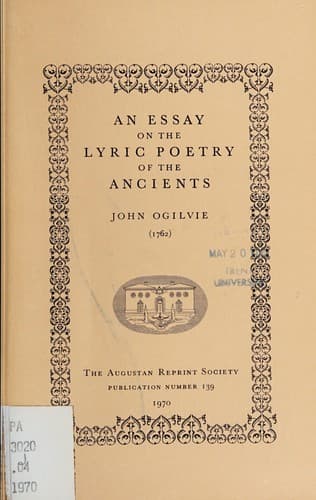
An Essay on the Lyric Poetry of the AncientsOgilvie, John
History
An Essay on the Lyric Poetry of the Ancients
Ogilvie, John
Classical poetry -- History and criticism
We must indeed acknowledge in general, that when an high degree of
spirit and vivacity is required to characterize any species of
composition, the Author may be allowed to take greater liberties than we
should grant to another, whose subject demanded regularity and
connection. Let it however be observed at the same time, that this
freedom is often granted, not because the theme indispensibly requires,
but because we naturally expect it from the genius of the Writer. We
justly suppose, that the Philosopher seldom mistakes his talents so far
as to be solicitous of shining in a sphere, for which he must know
himself to be wholly disqualified; and from the work of a Poet who
addresseth imagination, we look for those marks of wildness and
incoherence which discover the extent of that faculty.
I have acknowledged in a former part of this Essay, that the shorter Ode
not only admits of bold and spirited transitions, but that these are in
many instances necessary to constitute a perfect imitation of
nature[72]. This observation however cannot be applied with so much
propriety to the other kinds of it, because the transport of passion is
abrupt, instantaneous, and the mind returns suddenly to the point from
which it had digressed. On the contrary, as the passions cannot be kept
on their full stretch for any considerable time, we expect that in the
higher species of Lyric Poetry, the Poet will keep the principal object
more immediately in his eye, and that his transitions will never make us
lose sight of it so far, as not to recall with ease the intermediate
points of connection.
[Footnote 72: Letter I. p. xxxiii.]
When this rule is not violated, we can enter with pleasure into the
design of the Poet, and consider his work as a whole in which every
separate member has its distinct and proper use. Thus, when Pindar is
celebrating Aristagoras, we can easily observe that the Poet’s oblique
encomium on the Father and friends of his Heroe, is introduced with
great propriety, as every remark of this kind reflects additional lustre
on the character of the principal personage[73]. We are even sometimes
highly entertained with digressions, which have not so near a relation
to the subject of the Ode as the last mentioned circumstance; because
though the immediate design is not going forward, we can still however
keep it in view with the same ease, as a traveller can do the public
road, from which he willingly makes an excursion to survey the
neighbouring country. Thus the noble panegyric upon the whole people
of Rhodes, and the account of their Founder Tlepolemus, which we meet
with in the Ode inscribed to Diagoras the Rhodian; these are happy and
beautiful embellishments, whose introduction enlivens the whole piece
with a proper variety of objects[74].
[Footnote 73: Pin. Nem. Ode XI.]
[Footnote 74: Id. Olym. Ode VII.]
Public-domain text, read in full here on John Shaqi.
Reviews
Reviews
No reviews yet
Be the first to share your thoughts on this work.
Join the Discussion
Join the discussion
Sign in to leave a comment or review.
Sign InorCreate an account