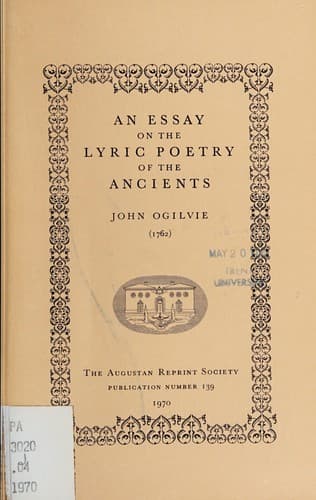
An Essay on the Lyric Poetry of the AncientsOgilvie, John
History
An Essay on the Lyric Poetry of the Ancients
Ogilvie, John
Classical poetry -- History and criticism
The second letter undertakes to explain the rules of lyric poetry, even
as the first was concerned with the defects and causes of the poetry.
Ogilvie rehearses a characteristic later eighteenth-century view of the
imagination and makes again the conventional distinctions between
faculties appropriate to philosophy and to poetry. His discussion of the
function of judgment is, if anything, more conventional within the
boundaries of neoclassic criticism than is his view of the imagination.
Its typical role as concerned with the “disposition of materials” has a
pedigree extending backward to Hobbes and the critical climate of the
early years of Restoration England. Principally, Ogilvie is eager to
assert that the poet is as judicious as the philosopher, by which,
however, he does not intend to put forth a view of the cognitive
function of the poet, but rather the justice with which he paints the
passions. Essentially, therefore, Ogilvie’s distinction between poet and
philosopher is for the sake of distinguishing between the former’s
greater interest in the passions, the latter’s more proper concern with
the reason. Once again there is nothing unusual in his treatment of the
subject at this time, with the possible exception that Ogilvie’s
conception of the imagination is not so comprehensive as that being
developed by Alexander Gerard, William Duff, and some of the other
contemporary associationists. In order, however, to
emphasize the importance of imagination, by which he largely means the
imagistic liveliness of the poet’s mind, he allows that the imagination
is secondary only in didactic or ethical poetry. Such forms are perhaps
best understood as hybrid, a kind of poetizing of philosophy, a sort of
reasoning in verse, and therefore forms in which the imagination is not
given full exercise. Given his premises it is not surprising that
Ogilvie often emphasizes ornamentation or imagistic display and supports
his position by conceiving of the modern lyric as descended from the
religiously consecrated ode. The sublime and exuberant imagery of the
latter exists reductively as an important virtue of the present lyric.
Public-domain text, read in full here on John Shaqi.
Reviews
Reviews
No reviews yet
Be the first to share your thoughts on this work.
Join the Discussion
Join the discussion
Sign in to leave a comment or review.
Sign InorCreate an account