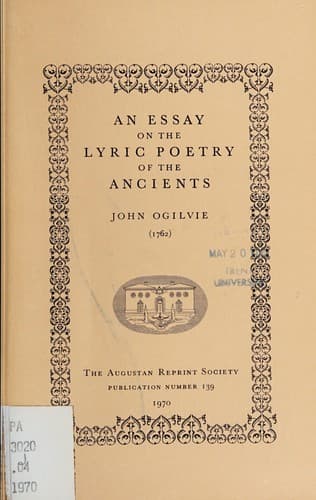
An Essay on the Lyric Poetry of the AncientsOgilvie, John
History
An Essay on the Lyric Poetry of the Ancients
Ogilvie, John
Classical poetry -- History and criticism
As Ogilvie develops his argument in the second letter, it is apparent
also that the imagination functions as that faculty which best
contemplates the sublime and the wonderful. The imagination is thus
contemplative and expressive, and both functions are justified through
the passions that admiration evokes. In sum, the imagination is evoked
by the passions, a proposition which suggests why, for Ogilvie, the
characteristic mark of genius is a highly animated sensibility. It is
apparent also that Ogilvie’s criteria include sympathy, for sympathy is
that which compels the transmission of the poet’s sentiments to his
readers. What is dimly present here is a theory of the poetic occasion,
an occasion brought about by the poet’s participation in a common
cultural condition which inspires the communication of sentiments, both
common and important, from one person to another. Corollary to this
proposition is the notion that the poetic achievement is measured by the
uniqueness of the poet’s invention. Thus, it is not merely the poet’s
choice of a sublime subject that is important, but also the excellence
with which he treats an unpromising subject. Ogilvie’s criteria demand
not merely a celerity of imagining, or a facility for the sublime, but a
degree of innovativeness which wins the highest regard.
To follow the argument is to realize that his conception of the
imagination includes judgment, celerity, and innovation. All three
functions are basic to the imaginative act. It is the last, however,
which he most emphasizes; and it is apparent, I think, that one
intention of his argument is to refute the assumption that the sublime
is the principal object of the poetic imagination. It is clear also that
Ogilvie is attentive to the excesses of imagism, even as he makes the
variety of a poet’s images (along with the boldness of his transitions
and the picturesque vivacity of his descriptions) one of the major terms
of critical assessment. Especially, he is attentive to that which
detracts from the principal object, and thus a kind of concentration of
purpose emerges as a tacit poetic value, a concentration to which he
refers as a “succession of sentiments which resemble ... the subject of
his Poem” (lii). Here again Ogilvie has not so much a unity of structure
in view as a unity of the passions, and it is this particular theme
which generally guides his discourse; it is the general premise upon
which his inquiry depends and on which his major justification of lyric
poetry is based. In more modern terms we might here speak of the
principle of the correlative, which Ogilvie rehearses in his treatment
of the correspondence of subject and metaphor, and even indeed of
metaphor as a mode of vision. Poetic discourse, for Ogilvie, does not
depend upon metaphor, but without metaphor such discourse would be
impossible.
Public-domain text, read in full here on John Shaqi.
Reviews
Reviews
No reviews yet
Be the first to share your thoughts on this work.
Join the Discussion
Join the discussion
Sign in to leave a comment or review.
Sign InorCreate an account