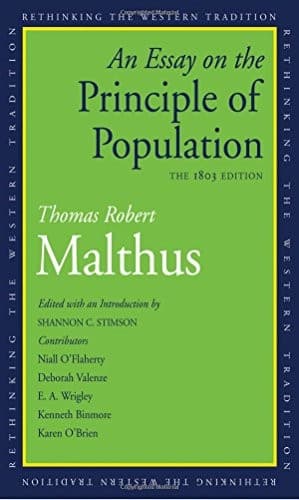
An Essay on the Principle of PopulationMalthus, T. R. (Thomas Robert)
Philosophy
An Essay on the Principle of Population
Malthus, T. R. (Thomas Robert)
Population
One principal reason is that the histories of mankind that we possess
are histories only of the higher classes. We have but few accounts that
can be depended upon of the manners and customs of that part of mankind
where these retrograde and progressive movements chiefly take place. A
satisfactory history of this kind, on one people, and of one period,
would require the constant and minute attention of an observing mind
during a long life. Some of the objects of inquiry would be, in what
proportion to the number of adults was the number of marriages, to what
extent vicious customs prevailed in consequence of the restraints upon
matrimony, what was the comparative mortality among the children of the
most distressed part of the community and those who lived rather more
at their ease, what were the variations in the real price of labour,
and what were the observable differences in the state of the lower
classes of society with respect to ease and happiness, at different
times during a certain period.
Such a history would tend greatly to elucidate the manner in which the
constant check upon population acts and would probably prove the
existence of the retrograde and progressive movements that have been
mentioned, though the times of their vibrations must necessarily be
rendered irregular from the operation of many interrupting causes, such
as the introduction or failure of certain manufactures, a greater or
less prevalent spirit of agricultural enterprise, years of plenty, or
years of scarcity, wars and pestilence, poor laws, the invention of
processes for shortening labour without the proportional extension of
the market for the commodity, and, particularly, the difference between
the nominal and real price of labour, a circumstance which has perhaps
more than any other contributed to conceal this oscillation from common
view.
It very rarely happens that the nominal price of labour universally
falls, but we well know that it frequently remains the same, while the
nominal price of provisions has been gradually increasing. This is, in
effect, a real fall in the price of labour, and during this period the
condition of the lower orders of the community must gradually grow
worse and worse. But the farmers and capitalists are growing rich from
the real cheapness of labour. Their increased capitals enable them to
employ a greater number of men. Work therefore may be plentiful, and
the price of labour would consequently rise. But the want of freedom in
the market of labour, which occurs more or less in all communities,
either from parish laws, or the more general cause of the facility of
combination among the rich, and its difficulty among the poor, operates
to prevent the price of labour from rising at the natural period, and
keeps it down some time longer; perhaps till a year of scarcity, when
the clamour is too loud and the necessity too apparent to be resisted.
Public-domain text, read in full here on John Shaqi.
Reviews
Reviews
No reviews yet
Be the first to share your thoughts on this work.
Join the Discussion
Join the discussion
Sign in to leave a comment or review.
Sign InorCreate an account