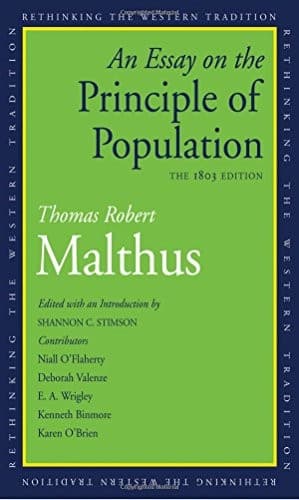
An Essay on the Principle of PopulationMalthus, T. R. (Thomas Robert)
Philosophy
An Essay on the Principle of Population
Malthus, T. R. (Thomas Robert)
Population
The way in which, these effects are produced seems to be this. We will
suppose the means of subsistence in any country just equal to the easy
support of its inhabitants. The constant effort towards population,
which is found to act even in the most vicious societies, increases the
number of people before the means of subsistence are increased. The
food therefore which before supported seven millions must now be
divided among seven millions and a half or eight millions. The poor
consequently must live much worse, and many of them be reduced to
severe distress. The number of labourers also being above the
proportion of the work in the market, the price of labour must tend
toward a decrease, while the price of provisions would at the same time
tend to rise. The labourer therefore must work harder to earn the same
as he did before. During this season of distress, the discouragements
to marriage, and the difficulty of rearing a family are so great that
population is at a stand. In the mean time the cheapness of labour, the
plenty of labourers, and the necessity of an increased industry amongst
them, encourage cultivators to employ more labour upon their land, to
turn up fresh soil, and to manure and improve more completely what is
already in tillage, till ultimately the means of subsistence become in
the same proportion to the population as at the period from which we
set out. The situation of the labourer being then again tolerably
comfortable, the restraints to population are in some degree loosened,
and the same retrograde and progressive movements with respect to
happiness are repeated.
This sort of oscillation will not be remarked by superficial observers,
and it may be difficult even for the most penetrating mind to calculate
its periods. Yet that in all old states some such vibration does exist,
though from various transverse causes, in a much less marked, and in a
much more irregular manner than I have described it, no reflecting man
who considers the subject deeply can well doubt.
Many reasons occur why this oscillation has been less obvious, and less
decidedly confirmed by experience, than might naturally be expected.
Public-domain text, read in full here on John Shaqi.
Reviews
Reviews
No reviews yet
Be the first to share your thoughts on this work.
Join the Discussion
Join the discussion
Sign in to leave a comment or review.
Sign InorCreate an account