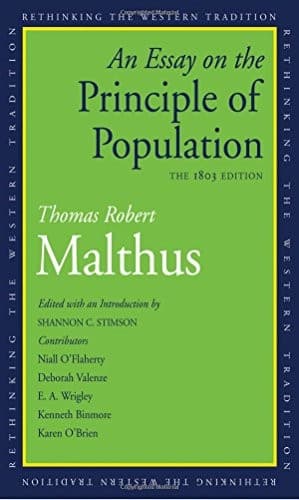
An Essay on the Principle of PopulationMalthus, T. R. (Thomas Robert)
Philosophy
An Essay on the Principle of Population
Malthus, T. R. (Thomas Robert)
Population
The view which he has given of human life has a melancholy hue, but he
feels conscious that he has drawn these dark tints from a conviction
that they are really in the picture, and not from a jaundiced eye or an
inherent spleen of disposition. The theory of mind which he has
sketched in the two last chapters accounts to his own understanding in
a satisfactory manner for the existence of most of the evils of life,
but whether it will have the same effect upon others must be left to
the judgement of his readers.
If he should succeed in drawing the attention of more able men to what
he conceives to be the principal difficulty in the way to the
improvement of society and should, in consequence, see this difficulty
removed, even in theory, he will gladly retract his present opinions
and rejoice in a conviction of his error.
7 June 1798
CHAPTER 1
Question stated--Little prospect of a determination of it, from the
enmity of the opposing parties--The principal argument against the
perfectibility of man and of society has never been fairly
answered--Nature of the difficulty arising from population--Outline of
the principal argument of the Essay
The great and unlooked for discoveries that have taken place of late
years in natural philosophy, the increasing diffusion of general
knowledge from the extension of the art of printing, the ardent and
unshackled spirit of inquiry that prevails throughout the lettered and
even unlettered world, the new and extraordinary lights that have been
thrown on political subjects which dazzle and astonish the
understanding, and particularly that tremendous phenomenon in the
political horizon, the French Revolution, which, like a blazing comet,
seems destined either to inspire with fresh life and vigour, or to
scorch up and destroy the shrinking inhabitants of the earth, have all
concurred to lead many able men into the opinion that we were touching
on a period big with the most important changes, changes that would in
some measure be decisive of the future fate of mankind.
It has been said that the great question is now at issue, whether man
shall henceforth start forwards with accelerated velocity towards
illimitable, and hitherto unconceived improvement, or be condemned to a
perpetual oscillation between happiness and misery, and after every
effort remain still at an immeasurable distance from the wished-for
goal.
Yet, anxiously as every friend of mankind must look forwards to the
termination of this painful suspense, and eagerly as the inquiring mind
would hail every ray of light that might assist its view into futurity,
it is much to be lamented that the writers on each side of this
momentous question still keep far aloof from each other. Their mutual
arguments do not meet with a candid examination. The question is not
brought to rest on fewer points, and even in theory scarcely seems to
be approaching to a decision.
Public-domain text, read in full here on John Shaqi.
Reviews
Reviews
No reviews yet
Be the first to share your thoughts on this work.
Join the Discussion
Join the discussion
Sign in to leave a comment or review.
Sign InorCreate an account