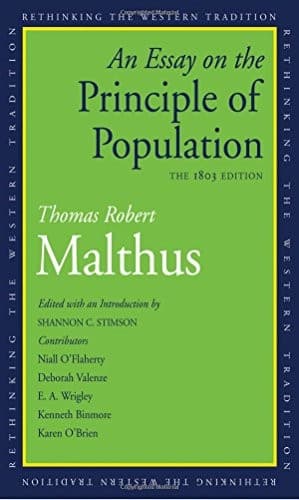
An Essay on the Principle of PopulationMalthus, T. R. (Thomas Robert)
Philosophy
An Essay on the Principle of Population
Malthus, T. R. (Thomas Robert)
Population
The advocate for the present order of things is apt to treat the sect
of speculative philosophers either as a set of artful and designing
knaves who preach up ardent benevolence and draw captivating pictures
of a happier state of society only the better to enable them to destroy
the present establishments and to forward their own deep-laid schemes
of ambition, or as wild and mad-headed enthusiasts whose silly
speculations and absurd paradoxes are not worthy the attention of any
reasonable man.
The advocate for the perfectibility of man, and of society, retorts on
the defender of establishments a more than equal contempt. He brands
him as the slave of the most miserable and narrow prejudices; or as the
defender of the abuses of civil society only because he profits by
them. He paints him either as a character who prostitutes his
understanding to his interest, or as one whose powers of mind are not
of a size to grasp any thing great and noble, who cannot see above five
yards before him, and who must therefore be utterly unable to take in
the views of the enlightened benefactor of mankind.
In this unamicable contest the cause of truth cannot but suffer. The
really good arguments on each side of the question are not allowed to
have their proper weight. Each pursues his own theory, little
solicitous to correct or improve it by an attention to what is advanced
by his opponents.
The friend of the present order of things condemns all political
speculations in the gross. He will not even condescend to examine the
grounds from which the perfectibility of society is inferred. Much less
will he give himself the trouble in a fair and candid manner to attempt
an exposition of their fallacy.
The speculative philosopher equally offends against the cause of truth.
With eyes fixed on a happier state of society, the blessings of which
he paints in the most captivating colours, he allows himself to indulge
in the most bitter invectives against every present establishment,
without applying his talents to consider the best and safest means of
removing abuses and without seeming to be aware of the tremendous
obstacles that threaten, even in theory, to oppose the progress of man
towards perfection.
It is an acknowledged truth in philosophy that a just theory will
always be confirmed by experiment. Yet so much friction, and so many
minute circumstances occur in practice, which it is next to impossible
for the most enlarged and penetrating mind to foresee, that on few
subjects can any theory be pronounced just, till all the arguments
against it have been maturely weighed and clearly and consistently
refuted.
Public-domain text, read in full here on John Shaqi.
Reviews
Reviews
No reviews yet
Be the first to share your thoughts on this work.
Join the Discussion
Join the discussion
Sign in to leave a comment or review.
Sign InorCreate an account