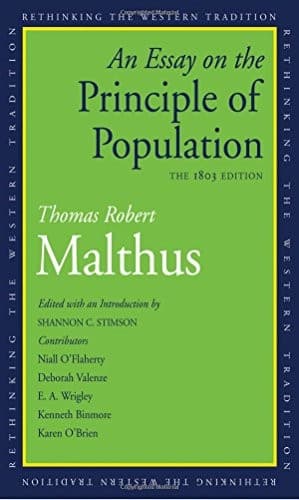
An Essay on the Principle of PopulationMalthus, T. R. (Thomas Robert)
Philosophy
An Essay on the Principle of Population
Malthus, T. R. (Thomas Robert)
Population
The preventive check appears to operate in some degree through all the
ranks of society in England. There are some men, even in the highest
rank, who are prevented from marrying by the idea of the expenses that
they must retrench, and the fancied pleasures that they must deprive
themselves of, on the supposition of having a family. These
considerations are certainly trivial, but a preventive foresight of
this kind has objects of much greater weight for its contemplation as
we go lower.
A man of liberal education, but with an income only just sufficient to
enable him to associate in the rank of gentlemen, must feel absolutely
certain that if he marries and has a family he shall be obliged, if he
mixes at all in society, to rank himself with moderate farmers and the
lower class of tradesmen. The woman that a man of education would
naturally make the object of his choice would be one brought up in the
same tastes and sentiments with himself and used to the familiar
intercourse of a society totally different from that to which she must
be reduced by marriage. Can a man consent to place the object of his
affection in a situation so discordant, probably, to her tastes and
inclinations? Two or three steps of descent in society, particularly at
this round of the ladder, where education ends and ignorance begins,
will not be considered by the generality of people as a fancied and
chimerical, but a real and essential evil. If society be held
desirable, it surely must be free, equal, and reciprocal society, where
benefits are conferred as well as received, and not such as the
dependent finds with his patron or the poor with the rich.
These considerations undoubtedly prevent a great number in this rank of
life from following the bent of their inclinations in an early
attachment. Others, guided either by a stronger passion, or a weaker
judgement, break through these restraints, and it would be hard indeed,
if the gratification of so delightful a passion as virtuous love, did
not, sometimes, more than counterbalance all its attendant evils. But I
fear it must be owned that the more general consequences of such
marriages are rather calculated to justify than to repress the
forebodings of the prudent.
The sons of tradesmen and farmers are exhorted not to marry, and
generally find it necessary to pursue this advice till they are settled
in some business or farm that may enable them to support a family.
These events may not, perhaps, occur till they are far advanced in
life. The scarcity of farms is a very general complaint in England. And
the competition in every kind of business is so great that it is not
possible that all should be successful.
Public-domain text, read in full here on John Shaqi.
Reviews
Reviews
No reviews yet
Be the first to share your thoughts on this work.
Join the Discussion
Join the discussion
Sign in to leave a comment or review.
Sign InorCreate an account