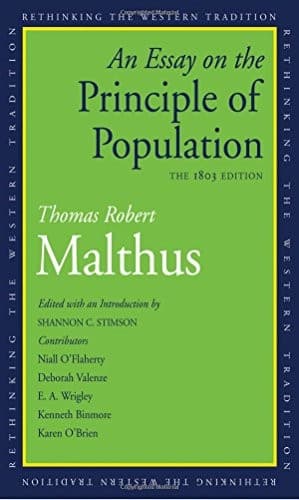
An Essay on the Principle of PopulationMalthus, T. R. (Thomas Robert)
Philosophy
An Essay on the Principle of Population
Malthus, T. R. (Thomas Robert)
Population
The labourer who earns eighteen pence a day and lives with some degree
of comfort as a single man, will hesitate a little before he divides
that pittance among four or five, which seems to be but just sufficient
for one. Harder fare and harder labour he would submit to for the sake
of living with the woman that he loves, but he must feel conscious, if
he thinks at all, that should he have a large family, and any ill luck
whatever, no degree of frugality, no possible exertion of his manual
strength could preserve him from the heart-rending sensation of seeing
his children starve, or of forfeiting his independence, and being
obliged to the parish for their support. The love of independence is a
sentiment that surely none would wish to be erased from the breast of
man, though the parish law of England, it must be confessed, is a
system of all others the most calculated gradually to weaken this
sentiment, and in the end may eradicate it completely.
The servants who live in gentlemen's families have restraints that are
yet stronger to break through in venturing upon marriage. They possess
the necessaries, and even the comforts of life, almost in as great
plenty as their masters. Their work is easy and their food luxurious
compared with the class of labourers. And their sense of dependence is
weakened by the conscious power of changing their masters, if they feel
themselves offended. Thus comfortably situated at present, what are
their prospects in marrying? Without knowledge or capital, either for
business, or farming, and unused and therefore unable, to earn a
subsistence by daily labour, their only refuge seems to be a miserable
ale-house, which certainly offers no very enchanting prospect of a
happy evening to their lives. By much the greater part, therefore,
deterred by this uninviting view of their future situation, content
themselves with remaining single where they are.
If this sketch of the state of society in England be near the truth,
and I do not conceive that it is exaggerated, it will be allowed that
the preventive check to population in this country operates, though
with varied force, through all the classes of the community. The same
observation will hold true with regard to all old states. The effects,
indeed, of these restraints upon marriage are but too conspicuous in
the consequent vices that are produced in almost every part of the
world, vices that are continually involving both sexes in inextricable
unhappiness.
CHAPTER 5
Public-domain text, read in full here on John Shaqi.
Reviews
Reviews
No reviews yet
Be the first to share your thoughts on this work.
Join the Discussion
Join the discussion
Sign in to leave a comment or review.
Sign InorCreate an account