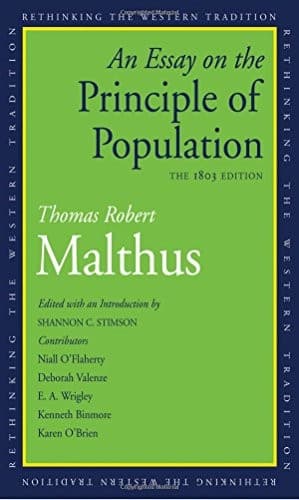
An Essay on the Principle of PopulationMalthus, T. R. (Thomas Robert)
Philosophy
An Essay on the Principle of Population
Malthus, T. R. (Thomas Robert)
Population
Supposing the quantity of food in any country to remain the same for
many years together, it is evident that this food must be divided
according to the value of each man's patent, or the sum of money that
he can afford to spend on this commodity so universally in request. (Mr
Godwin calls the wealth that a man receives from his ancestors a mouldy
patent. It may, I think, very properly be termed a patent, but I hardly
see the propriety of calling it a mouldy one, as it is an article in
such constant use.) It is a demonstrative truth, therefore, that the
patents of one set of men could not be increased in value without
diminishing the value of the patents of some other set of men. If the
rich were to subscribe and give five shillings a day to five hundred
thousand men without retrenching their own tables, no doubt can exist,
that as these men would naturally live more at their ease and consume a
greater quantity of provisions, there would be less food remaining to
divide among the rest, and consequently each man's patent would be
diminished in value or the same number of pieces of silver would
purchase a smaller quantity of subsistence.
An increase of population without a proportional increase of food will
evidently have the same effect in lowering the value of each man's
patent. The food must necessarily be distributed in smaller quantities,
and consequently a day's labour will purchase a smaller quantity of
provisions. An increase in the price of provisions would arise either
from an increase of population faster than the means of subsistence, or
from a different distribution of the money of the society. The food of
a country that has been long occupied, if it be increasing, increases
slowly and regularly and cannot be made to answer any sudden demands,
but variations in the distribution of the money of a society are not
infrequently occurring, and are undoubtedly among the causes that
occasion the continual variations which we observe in the price of
provisions.
The poor laws of England tend to depress the general condition of the
poor in these two ways. Their first obvious tendency is to increase
population without increasing the food for its support. A poor man may
marry with little or no prospect of being able to support a family in
independence. They may be said therefore in some measure to create the
poor which they maintain, and as the provisions of the country must, in
consequence of the increased population, be distributed to every man in
smaller proportions, it is evident that the labour of those who are not
supported by parish assistance will purchase a smaller quantity of
provisions than before and consequently more of them must be driven to
ask for support.
Public-domain text, read in full here on John Shaqi.
Reviews
Reviews
No reviews yet
Be the first to share your thoughts on this work.
Join the Discussion
Join the discussion
Sign in to leave a comment or review.
Sign InorCreate an account