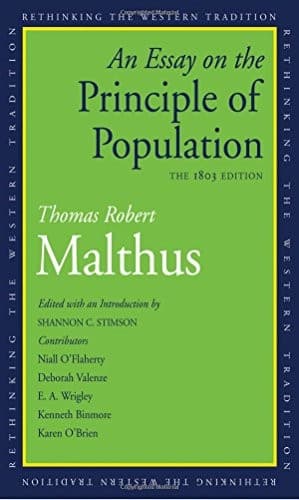
An Essay on the Principle of PopulationMalthus, T. R. (Thomas Robert)
Philosophy
An Essay on the Principle of Population
Malthus, T. R. (Thomas Robert)
Population
It will be said, perhaps, that the increased number of purchasers in
every article would give a spur to productive industry and that the
whole produce of the island would be increased. This might in some
degree be the case. But the spur that these fancied riches would give
to population would more than counterbalance it, and the increased
produce would be to be divided among a more than proportionably
increased number of people. All this time I am supposing that the same
quantity of work would be done as before. But this would not really
take place. The receipt of five shillings a day, instead of eighteen
pence, would make every man fancy himself comparatively rich and able
to indulge himself in many hours or days of leisure. This would give a
strong and immediate check to productive industry, and, in a short
time, not only the nation would be poorer, but the lower classes
themselves would be much more distressed than when they received only
eighteen pence a day.
A collection from the rich of eighteen shillings in the pound, even if
distributed in the most judicious manner, would have a little the same
effect as that resulting from the supposition I have just made, and no
possible contributions or sacrifices of the rich, particularly in
money, could for any time prevent the recurrence of distress among the
lower members of society, whoever they were. Great changes might,
indeed, be made. The rich might become poor, and some of the poor rich,
but a part of the society must necessarily feel a difficulty of living,
and this difficulty will naturally fall on the least fortunate members.
It may at first appear strange, but I believe it is true, that I cannot
by means of money raise a poor man and enable him to live much better
than he did before, without proportionably depressing others in the
same class. If I retrench the quantity of food consumed in my house,
and give him what I have cut off, I then benefit him, without
depressing any but myself and family, who, perhaps, may be well able to
bear it. If I turn up a piece of uncultivated land, and give him the
produce, I then benefit both him and all the members of the society,
because what he before consumed is thrown into the common stock, and
probably some of the new produce with it. But if I only give him money,
supposing the produce of the country to remain the same, I give him a
title to a larger share of that produce than formerly, which share he
cannot receive without diminishing the shares of others. It is evident
that this effect, in individual instances, must be so small as to be
totally imperceptible; but still it must exist, as many other effects
do, which, like some of the insects that people the air, elude our
grosser perceptions.
Public-domain text, read in full here on John Shaqi.
Reviews
Reviews
No reviews yet
Be the first to share your thoughts on this work.
Join the Discussion
Join the discussion
Sign in to leave a comment or review.
Sign InorCreate an account